Early warning

Early Warning of Upcoming CVE Disclosures

Get ahead of new CVEs on the systems you care about.

Overview

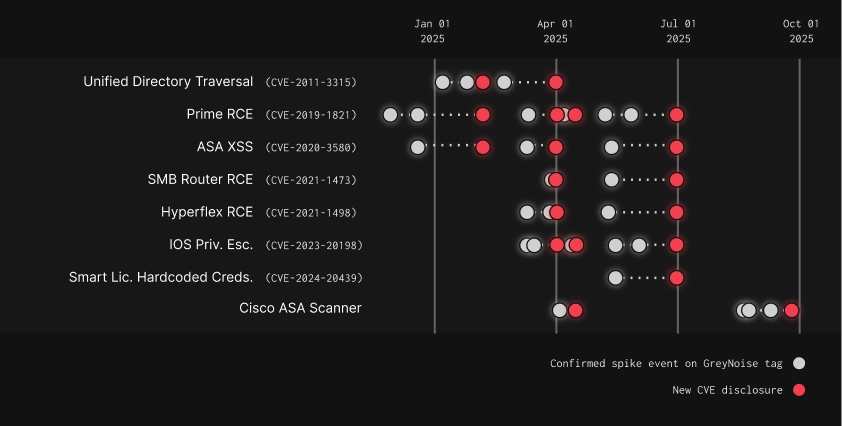
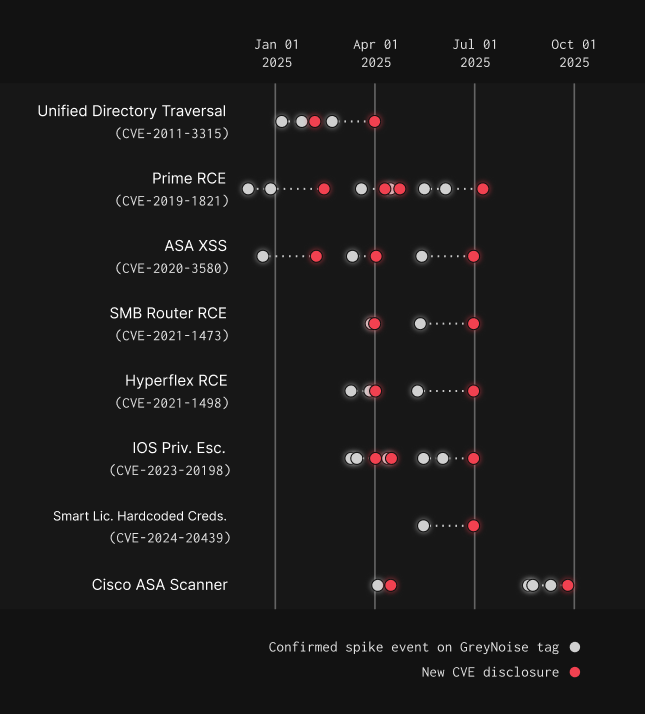
GreyNoise research shows that spikes in traffic targeting older CVEs often precede new CVE disclosures for that same vendor within weeks. These early warnings give organizations time to harden systems, patch, monitor, or block probing IPs.

By detecting shifts in attacker reconnaissance prior to CVE disclosure, GreyNoise provides a critical window of opportunity to prepare before a threat materializes.
How GreyNoise Helps You
Prepare for New CVEs

Provides Time to Prepare

When a new CVE hits critical perimeter systems, it can trigger emergency response and disruption. Early warnings from GreyNoise let teams prepare in advance and minimize impact

Aligns Risk Assessments to Real-World Threat Activity

GreyNoise shows which vendors and technologies are seeing abnormal reconnaissance levels, keeping risk assessments aligned with real-world signals.

Improves Resource Allocation

Defenders can focus investments, patching, and monitoring on upcoming threats most likely to impact them.

Enables Proactive Blocking

Use GreyNoise query-based, dynamic blocklists to stop attacks as your organization patches exposed systems.

Explore Available Fields

Filter by category & search available IP fields and their uses with GreyNoise.
Categories
Thank you! Your submission has been received!
Oops! Something went wrong while submitting the form.
NAME
Description & Use
ASN Count
Count of IPs grouped by ASN. Supports ASN-level threat analysis.
Stats & Aggregates
Protocol
Protocol (e.g., TCP/UDP) used in scanning activity. Adds layer-4 context.
Observed Request Data
Port
Port observed in scanning activity. Useful for identifying targeted services.
Observed Request Data
Destination ASNs
List of ASNs targeted by the IP. Helps show which networks are being scanned.
Sensor Metadata
Sensor Hits
Total number of events GreyNoise sensors recorded from this IP. Indicates activity volume.
Sensor Metadata
Source Latitude
Latitude of IP’s registered location. Useful for geo-mapping.
IP Address Metadata
Destination Cities
List of cities where scanning traffic was observed. Useful for geo-targeting analysis.
Sensor Metadata
Sensor Count
Number of distinct sensors that saw the IP. Higher values indicates wider scanning footprint.
Sensor Metadata
First Seen
Date the IP was first observed by GreyNoise. Indicates activity lifetime.
Activity Timeline
VPN Service
Name of the VPN service associated with the IP. Useful for attribution and filtering.
IP Address Metadata
VPN
Flags if the IP belongs to a VPN provider. Suggests identity masking or evasive behavior.
IP Address Metadata
Updated At
Date/time when the tag was last updated.
Tag Information
Slug
Short identifier for the tag. Useful in queries and API lookups.
Tag Information
References
References (e.g., CVE pages, docs) supporting the tag. Provides analyst enrichment sources.
Tag Information
Recommended Block
Indicates whether IPs with this tag should be blocked. Supports automated policy decisions.
Tag Information
Name
Display name of the tag. Analyst-facing label for quick recognition.
Tag Information
Exploitation Activity Threat IP Count (1d)
Total number of threat IPs GreyNoise observed scanning or exploiting this vulnerability today.
Exploitation Activity
Exploitation Activity Threat IP Count (30d)
Total number of threat IPs GreyNoise observed scanning or exploiting this vulnerability in the last 30 days. Useful for long-term prioritization and trend analysis.
Exploitation Activity
Exploitation Activity Threat IP Count (10d)
Total number of threat IPs GreyNoise observed scanning or exploiting this vulnerability in the last 10 days.
Exploitation Activity
Exploitation Activity Benign IP Count (30d)
Total number of benign IPs GreyNoise observed scanning or exploiting this vulnerability in the last 30 days.
Exploitation Activity
Exploitation Activity Benign IP Count (10d)
Total number of benign IPs GreyNoise observed scanning or exploiting this vulnerability in the last 10 days.
Exploitation Activity
Exploitation Activity Seen
Whether GreyNoise has observed activity related to this CVE.
Exploitation Activity
Exploitation Activity Benign IP Count (1d)
Total number of benign IPs GreyNoise observed scanning or exploiting this vulnerability today.
Exploitation Activity
Exploitation Stats Number of Botnets Exploiting Vulnerability
Total number of botnets exploiting the vulnerability.
Exploitation Statistics
Exploitation Activity
Observed IPs scanning or exploiting the vulnerability today, in the last 10 days, and the last 30 days.
Exploitation Activity
Exploitation Stats Number of Threat Actors Exploiting Vulnerability
Total number of known threat actors exploiting the vulnerability.
Exploitation Statistics
Exploitation Details Registered in KEV
Whether exploitation has been registered in the KEV (Known Exploited Vulnerabilities) database.
Exploitation Intelligence
Exploitation Stats Number of Available Exploits
Total number of exploits available (public + commercial).
Exploitation Statistics
Exploitation Stats
Statistical data about exploitation, including number of exploits available, and number of threat actors and botnets exploiting the vulnerability.
Exploitation Statistics
Exploitation Details Exploit Found
Indicates whether a working exploit is publicly available. Confirms attacker capability and should increase remediation priority.
Exploitation Intelligence
Exploitation Details EPSS Score
EPSS score (Exploit Prediction Scoring System) associated with the exploitation.
Exploitation Intelligence
Exploitation Details Attack Vector
The method attackers use to exploit the vulnerability (e.g., network, local, adjacent). Helps assess exposure across internet-facing vs. internal assets.
Exploitation Intelligence

Don't wait until it's a CVE