Early warning

Early Warning of Upcoming CVE Disclosures

Get ahead of new CVEs on the systems you care about.

Overview

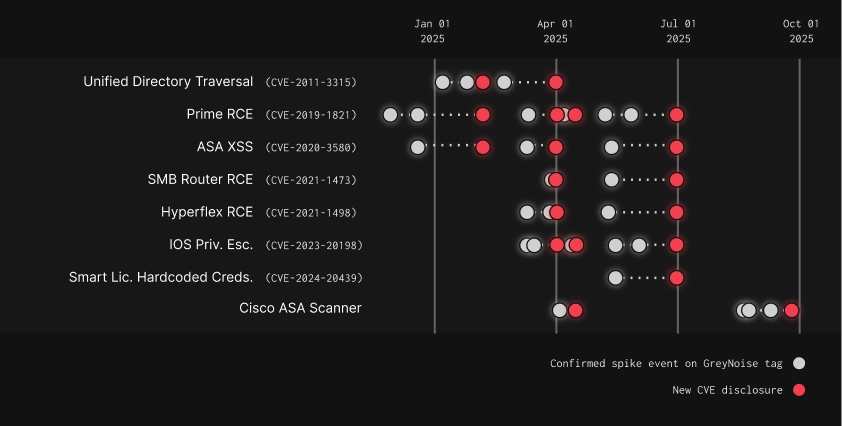
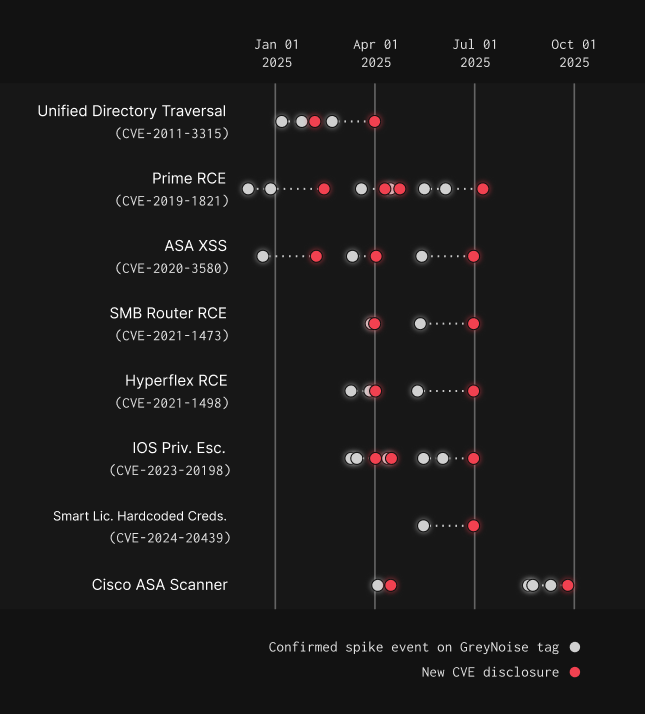
GreyNoise research shows that spikes in traffic targeting older CVEs often precede new CVE disclosures for that same vendor within weeks. These early warnings give organizations time to harden systems, patch, monitor, or block probing IPs.

By detecting shifts in attacker reconnaissance prior to CVE disclosure, GreyNoise provides a critical window of opportunity to prepare before a threat materializes.
How GreyNoise Helps You
Prepare for New CVEs

Provides Time to Prepare

When a new CVE hits critical perimeter systems, it can trigger emergency response and disruption. Early warnings from GreyNoise let teams prepare in advance and minimize impact

Aligns Risk Assessments to Real-World Threat Activity

GreyNoise shows which vendors and technologies are seeing abnormal reconnaissance levels, keeping risk assessments aligned with real-world signals.

Improves Resource Allocation

Defenders can focus investments, patching, and monitoring on upcoming threats most likely to impact them.

Enables Proactive Blocking

Use GreyNoise query-based, dynamic blocklists to stop attacks as your organization patches exposed systems.

Explore Available Fields

Filter by category & search available IP fields and their uses with GreyNoise.
Categories
Thank you! Your submission has been received!
Oops! Something went wrong while submitting the form.
NAME
Description & Use
Source Country
Country where the IP is registered. Provides attacker infrastructure location context.
IP Address Metadata
Organization
Organization responsible for the IP. Adds enrichment for attribution.
IP Address Metadata
Single Destination
True if the IP only scanned one country. Suggests targeted reconnaissance.
IP Address Metadata
Region
State/province where the IP is registered. Adds sub-country geolocation context.
IP Address Metadata
RDNS
Reverse DNS value for the IP. May reveal hostnames tied to services or campaigns.
IP Address Metadata
RDNS Parent
Parent domain of the reverse DNS. Useful for clustering infrastructure.
IP Address Metadata
Mobile
Indicates if the IP belongs to a mobile/cellular network.
IP Address Metadata
Domain
Domain tied to the ASN owner. Provides higher-level ownership context.
IP Address Metadata
Destination Country Codes
ISO codes for countries targeted by scanning. Supports correlation with geo-based IOCs.
IP Address Metadata
Destination Countries
Countries where GreyNoise sensors saw this IP scanning. Indicates target geography.
IP Address Metadata
City
Registered city of the IP. Useful for geolocation context and pivoting.
IP Address Metadata
Category
High-level network type (e.g., hosting, ISP, enterprise).
IP Address Metadata
ASN
Autonomous System Number routing the IP. Helps group malicious infrastructure.
IP Address Metadata
Last Seen Timestamp
Exact date and time the IP was last observed. Enables timeline reconstruction in investigations.
Activity Timeline
Actor
Known or attributed owner/operator of the IP (e.g., research org, ISP, hosting provider). Useful for attribution.
Identity & Ownership
Classification
GreyNoise’s judgment of the IP’s intent: benign, malicious, suspicious, or unknown. Most useful filter for triage.
Classification
Exploitation Details
Exploitation-related details pertaining to attack vector category, EPSS score (Exploit Prediction Scoring System), available exploits, and KEV (Known Exploited Vulnerabilities) registration. Guides whether to prioritize based on real-world attacker use.
Exploitation Intelligence
Timeline CVE Last Updated Date
The last date the CVE entry was updated in the database. Useful for tracking changes in severity, affected products, or exploit status.
Timeline & Lifecycle
Timeline CISA KEV Date Added
Date the vulnerability was added to CISA’s Known Exploited Vulnerabilities (KEV) catalog. Vulnerabilities in KEV should be prioritized for remediation per federal guidance.
Timeline & Lifecycle
Timeline First Known Published Date
Date when the first exploit associated with the CVE was published.
Timeline & Lifecycle
Timeline CVE Published Date
The date the CVE was first published. Helps determine how long attackers have potentially been aware of the vulnerability.
Timeline & Lifecycle
Timeline
Key timeline details about when the CVE was published, updated, and added to CISA (https://www.cisa.gov/known-exploited-vulnerabilities-catalog). Useful for understanding how long the issue has been known.
Timeline & Lifecycle
Details Published to NIST NVD
Indicates if the vulnerability is published in the NIST National Vulnerability Database. Confirms official recognition and ensures compatibility with standard risk feeds.
Identification & Details
Details CVE CVSS Score
CVSS score assigned to the CVE. Commonly used in risk scoring but should be weighed alongside exploitation activity.
Identification & Details
Details Vendor
The vendor or developer responsible for the affected product. Helps map vulnerabilities to vendor patch advisories and SLAs.
Identification & Details
Details Product
The product affected by the vulnerability (e.g., Apache HTTP Server). Used to match against an organization’s asset inventory for prioritization.
Identification & Details
Details Vulnerability Description
Summary of what the vulnerability is and how it works. Helps analysts understand potential impact and determine exploitability in their environment.
Identification & Details
Details Vulnerability Name
Human-readable name of the vulnerability. Practitioners use this for quick recognition when scanning advisories.
Identification & Details
Details
Basic CVE details, including CVSS score (Common Vulnerability Scoring System), associated products & vendors, and NIST CVE recognition status. Provides context on the vulnerability itself.
Identification & Details
ID
Unique identifier for the record. Used to track and reference the vulnerability consistently across systems and reports.
Identification & Details
Source Bytes
Number of bytes sent from source IP. Useful for traffic analysis.
Observed Request Data
Source Longitude
Longitude of IP’s registered location. Useful for geo-mapping.
IP Address Metadata

Don't wait until it's a CVE