Threat Hunting

Needle in the haystack. Found

Quickly identify anomalous behavior and catch targeted threats

Overview

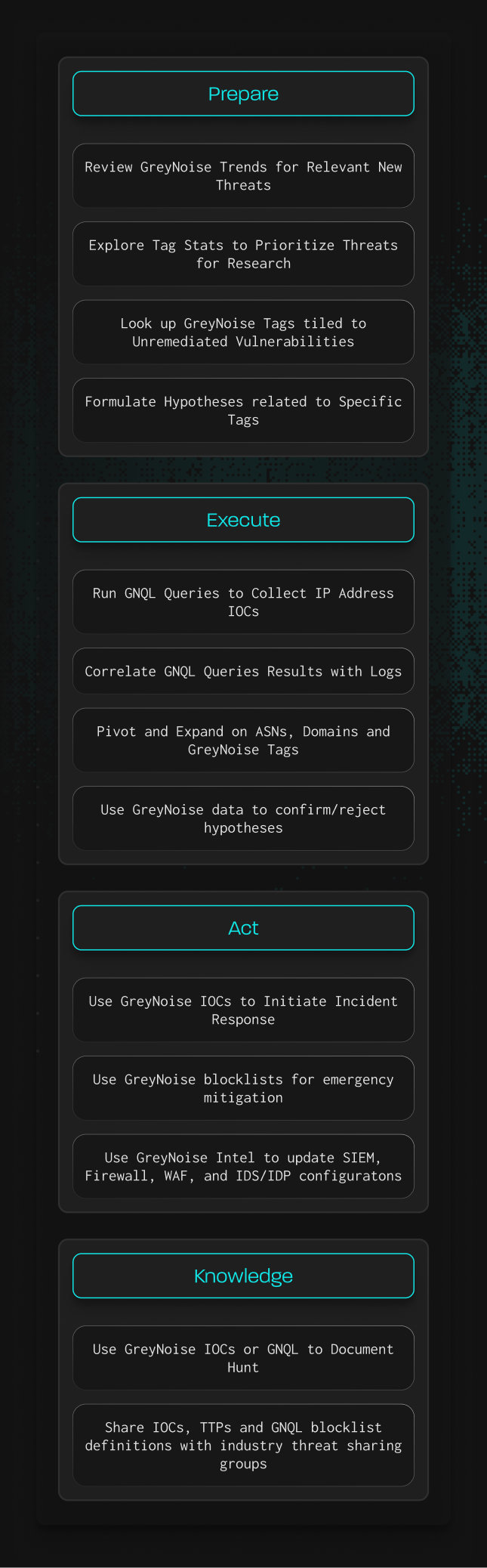
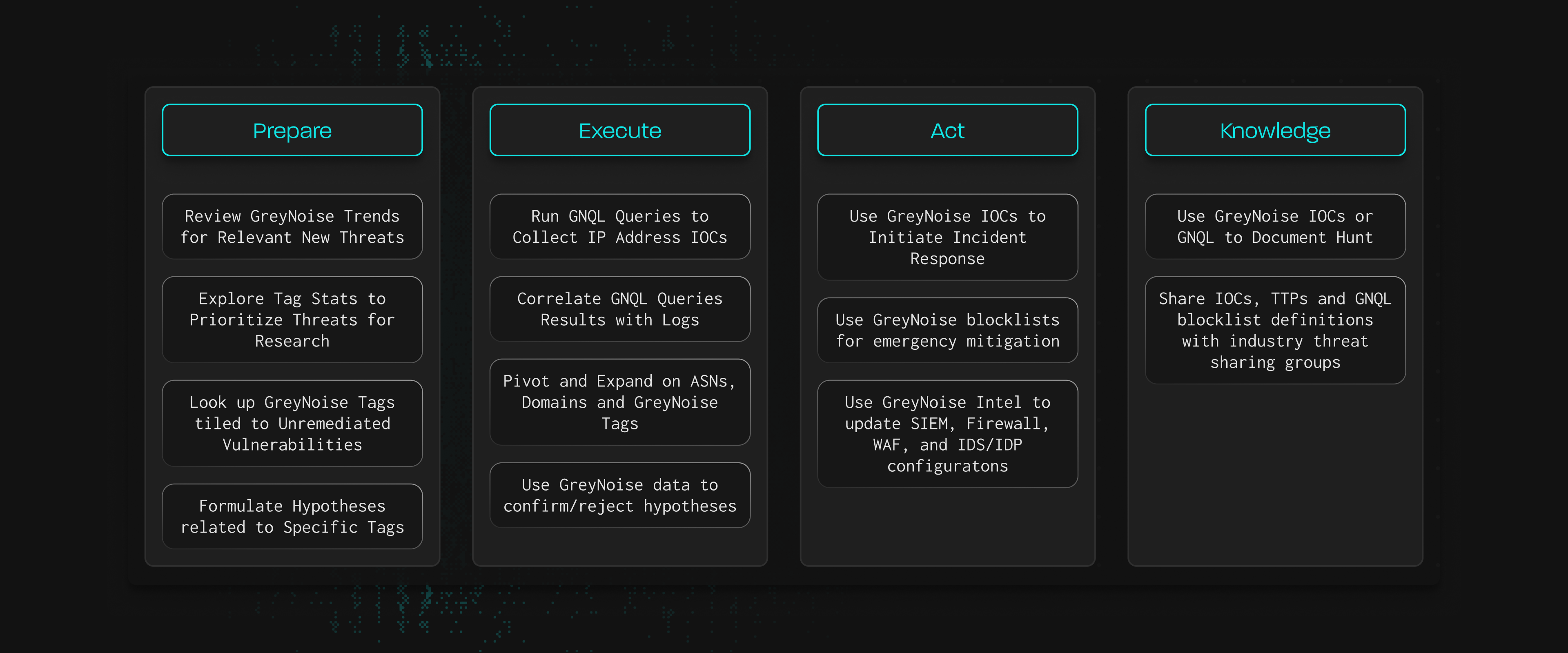
Effective threat hunting isn't just about finding more data, it’s about finding the right data. GreyNoise empowers your hunt team to adopt the PEAK Framework by correlating your internal traffic against our real-time map of internet-wide mass scanning.

By using GreyNoise to filter out opportunistic probes, benign scanners, and botnet noise, you reveal the statistically significant anomalies that represent targeted attacks. Stop chasing false positives and focus on the signals that actually threaten your perimeter.
How GreyNoise
Helps You Hunt Smarter

Focus effort on highest risks

Eliminate time-consuming research of benign and opportunistic scanning, allowing hunters to focus on infrastructure actually used by threat actors.

Supports threat research and hypothesis development

Hunters can use GreyNoise to conduct threat research, validate assumptions, and explore attack vectors in order to develop hypotheses.

Correlate isolated incidents

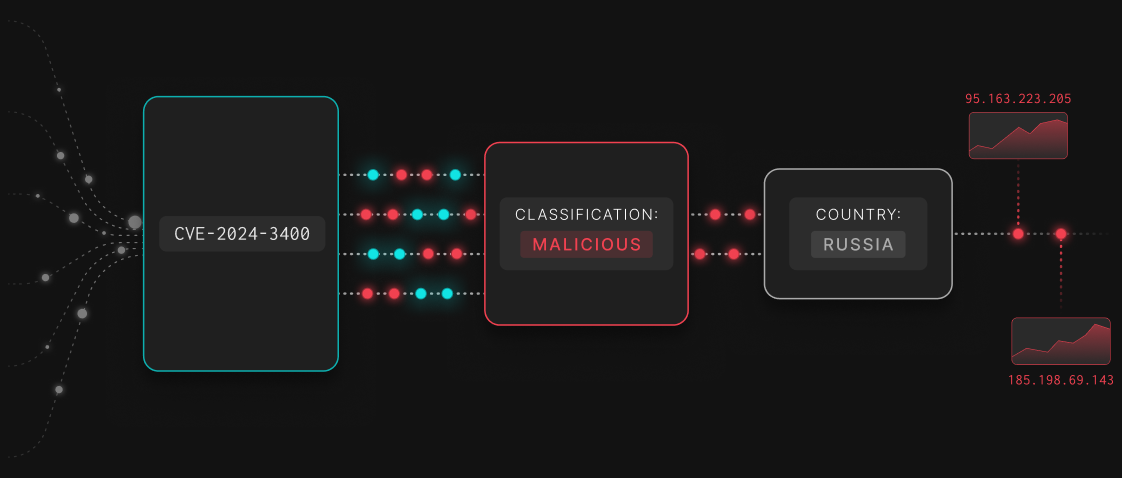
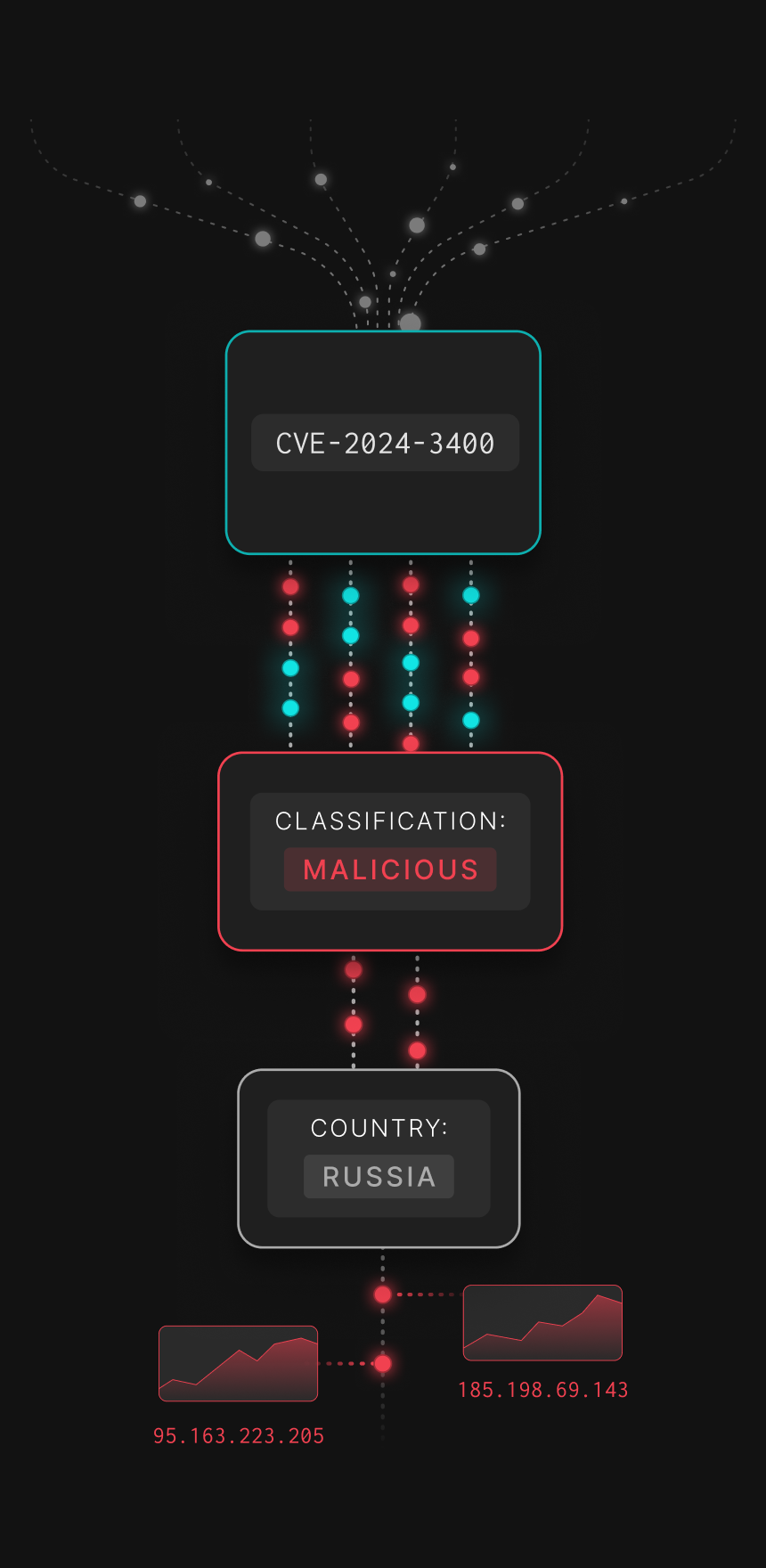
GreyNoise helps threat hunters link isolated incidents to larger campaigns by mapping attacker infrastructure and patterns, connecting logged IPs to those exploiting relevant vulnerabilities.

How GreyNoise Maps to the PEAK Hunting Framework
Explore Available Fields

Filter by category & search available IP fields and their uses with GreyNoise.
Categories
Thank you! Your submission has been received!
Oops! Something went wrong while submitting the form.
NAME
Description & Use
ASN
Autonomous System Number routing the IP. Helps group malicious infrastructure.
IP Address Metadata
ASN Count
Count of IPs grouped by ASN. Supports ASN-level threat analysis.
Stats & Aggregates
Actor
Known or attributed owner/operator of the IP (e.g., research org, ISP, hosting provider). Useful for attribution.
Identity & Ownership
Actor Count
Aggregated count of IPs per actor. Supports statistical analysis of actors.
Stats & Aggregates
Bot
Flags whether the IP is part of known botnet activity. Helps detect automated scanning or malware distribution.
Classification
CVE
List of CVEs the IP has scanned for or attempted to exploit. Critical for vulnerability triage.
Vulnerability Intelligence
CVEs
CVEs tied to the tag behavior. Critical for identifying exploitation of known vulnerabilities.
Tag Information
Category
High-level network type (e.g., hosting, ISP, enterprise).
IP Address Metadata
Category Count
Aggregated count of IPs per category (hosting, ISP, etc.). Highlights infrastructure trends.
Stats & Aggregates
City
Registered city of the IP. Useful for geolocation context and pivoting.
IP Address Metadata
Classification
GreyNoise’s judgment of the IP’s intent: benign, malicious, suspicious, or unknown. Most useful filter for triage.
Classification
Classification Count
Aggregated count of IPs per classification. Useful for threat landscape analysis.
Stats & Aggregates
Created At
Date the tag was first added. Indicates when this behavior was first observed.
Tag Information
Description
Human-readable explanation of what the tag represents. Adds analyst context.
Tag Information
Destination ASNs
List of ASNs targeted by the IP. Helps show which networks are being scanned.
Sensor Metadata
Destination Cities
List of cities where scanning traffic was observed. Useful for geo-targeting analysis.
Sensor Metadata
Exploitation Activity Threat IP Count (10d)
Total number of threat IPs GreyNoise observed scanning or exploiting this vulnerability in the last 10 days.
Exploitation Activity
Exploitation Activity Threat IP Count (1d)
Total number of threat IPs GreyNoise observed scanning or exploiting this vulnerability today.
Exploitation Activity
Exploitation Activity Threat IP Count (30d)
Total number of threat IPs GreyNoise observed scanning or exploiting this vulnerability in the last 30 days. Useful for long-term prioritization and trend analysis.
Exploitation Activity
Exploitation Details
Exploitation-related details pertaining to attack vector category, EPSS score (Exploit Prediction Scoring System), available exploits, and KEV (Known Exploited Vulnerabilities) registration. Guides whether to prioritize based on real-world attacker use.
Exploitation Intelligence
Exploitation Details Attack Vector
The method attackers use to exploit the vulnerability (e.g., network, local, adjacent). Helps assess exposure across internet-facing vs. internal assets.
Exploitation Intelligence
Exploitation Details EPSS Score
EPSS score (Exploit Prediction Scoring System) associated with the exploitation.
Exploitation Intelligence
Exploitation Details Exploit Found
Indicates whether a working exploit is publicly available. Confirms attacker capability and should increase remediation priority.
Exploitation Intelligence
Exploitation Details Registered in KEV
Whether exploitation has been registered in the KEV (Known Exploited Vulnerabilities) database.
Exploitation Intelligence
Exploitation Stats
Statistical data about exploitation, including number of exploits available, and number of threat actors and botnets exploiting the vulnerability.
Exploitation Statistics
Exploitation Stats Number of Available Exploits
Total number of exploits available (public + commercial).
Exploitation Statistics
Exploitation Stats Number of Botnets Exploiting Vulnerability
Total number of botnets exploiting the vulnerability.
Exploitation Statistics
Exploitation Stats Number of Threat Actors Exploiting Vulnerability
Total number of known threat actors exploiting the vulnerability.
Exploitation Statistics
First Seen
Date the IP was first observed by GreyNoise. Indicates activity lifetime.
Activity Timeline
HTTP Cookie Keys
HTTP cookie keys observed in scanning activity. Useful for identifying web scanners/exploit kits.
Protocol Data
HTTP Host
HTTP Host headers observed. Provides web attack targeting clues.
Protocol Data
HTTP MD5
MD5 hash of observed HTTP payloads. Useful for malware identification.
Protocol Data

Find your needle.