Compromised Asset Detection

Detect Compromised Assets

Detect outbound traffic probing GreyNoise sensors or talking with malicious IPs

Overview

Today's threat actors use botnets to scan for vulnerable systems and launch mass, automated attacks. To do this, compromising edge systems are critical to their operations.

Compromised devices often behave like attacker infrastructure, making it likely that a compromised device will probe the GreyNoise sensor network or interact with a known malicious IP.
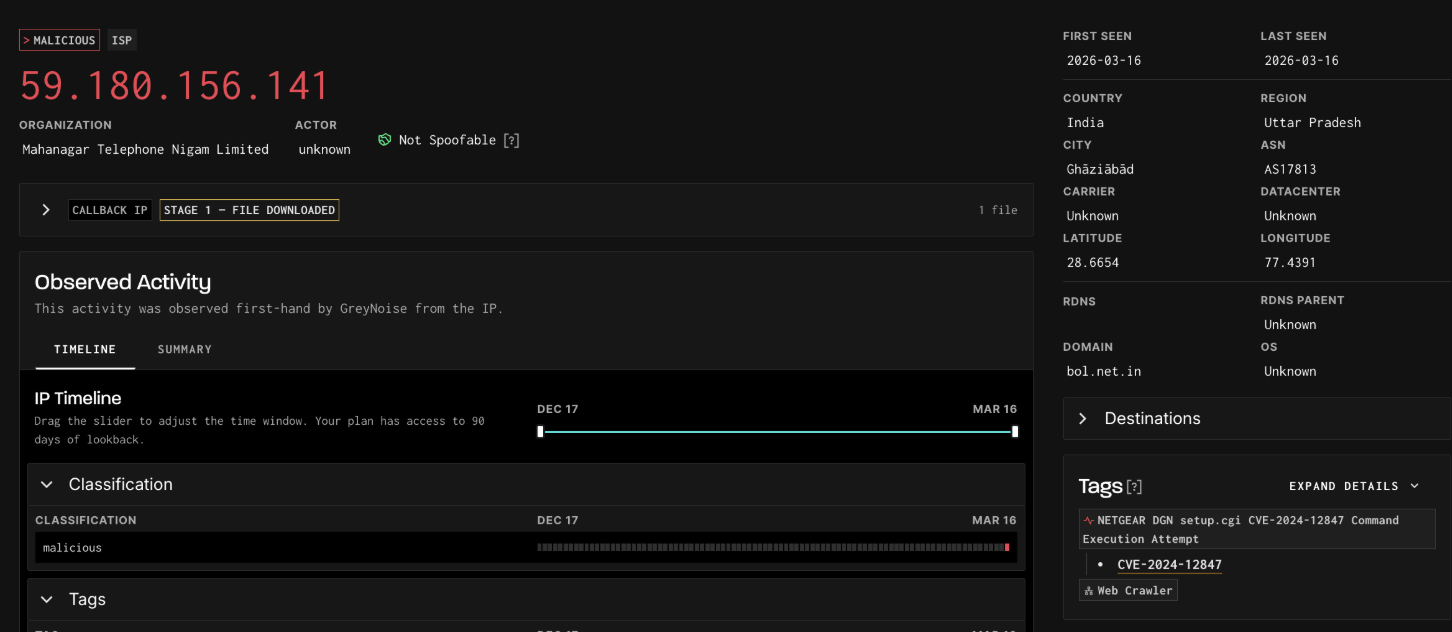
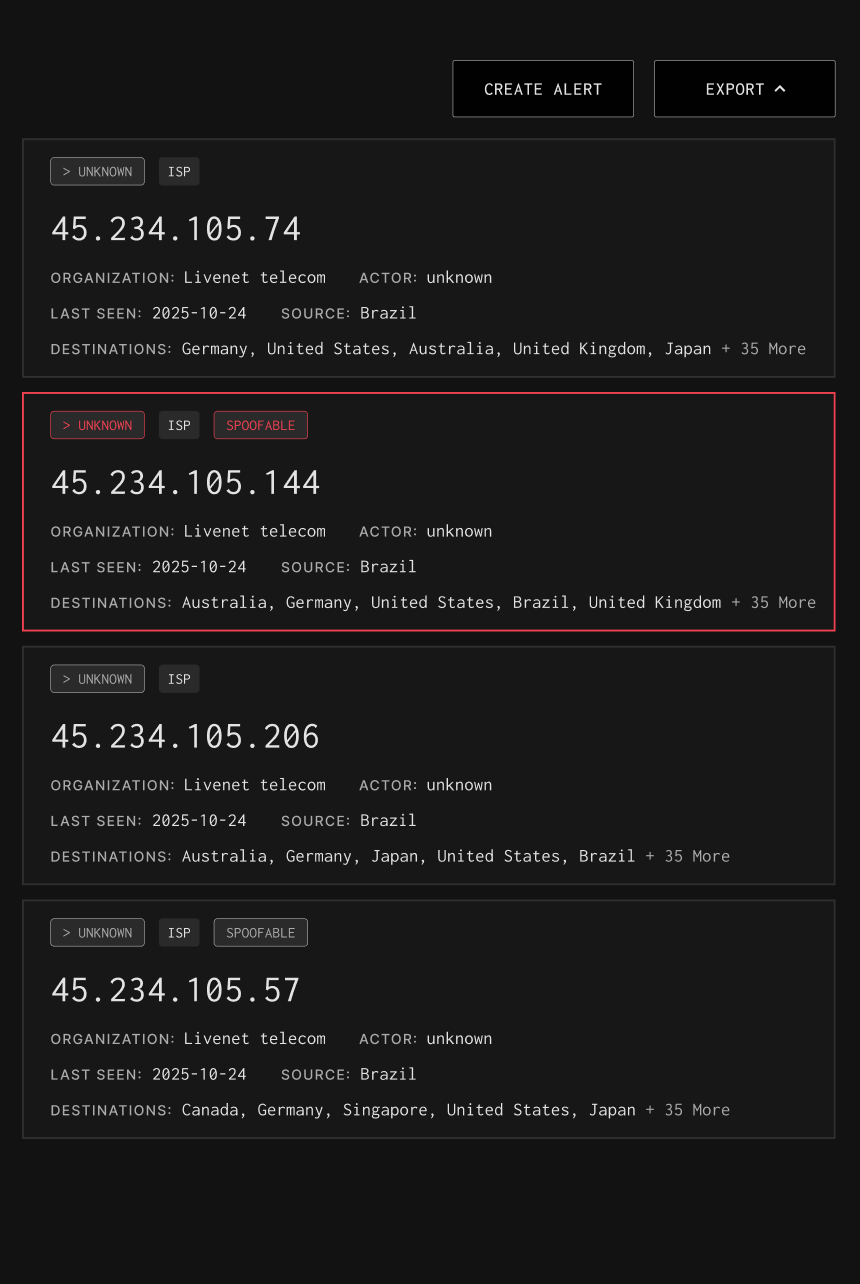
GreyNoise can help you quickly spot if you have a compromised host on your network edge.

How GreyNoise Helps You
Find Your Compromised Assets

Identify Abnormal Outbound Traffic

GreyNoise detects when your internal system contacts our global sensor network or is talking with a known malicious IP, both are strong indicators of compromise.

Faster Containment

Early visibility into compromised assets allows defenders to contain hosts, halting lateral movement.

Strengthen Incident Investigations

GreyNoise helps to establish a timeline of when a compromised device began scanning and exploitation.

Stop Outbound Connections to Malicious IPs

GreyNoise provides query-based, dynamic blocklists that prevent devices on your network from outbound communications with malicious IP addresses.

How it Works

Explore Available Fields

Filter by category & search available IP fields and their uses with GreyNoise.
Categories
Thank you! Your submission has been received!
Oops! Something went wrong while submitting the form.
NAME
Description & Use
Destination Countries
Countries where GreyNoise sensors saw this IP scanning. Indicates target geography.
IP Address Metadata
City
Registered city of the IP. Useful for geolocation context and pivoting.
IP Address Metadata
Category
High-level network type (e.g., hosting, ISP, enterprise).
IP Address Metadata
ASN
Autonomous System Number routing the IP. Helps group malicious infrastructure.
IP Address Metadata
Last Seen Timestamp
Exact date and time the IP was last observed. Enables timeline reconstruction in investigations.
Activity Timeline
Actor
Known or attributed owner/operator of the IP (e.g., research org, ISP, hosting provider). Useful for attribution.
Identity & Ownership
Classification
GreyNoise’s judgment of the IP’s intent: benign, malicious, suspicious, or unknown. Most useful filter for triage.
Classification
Last Seen
Last date the IP was observed by GreyNoise sensors. Indicates recency of activity.
Activity Timeline
IP
The observed IP address itself. Primary entity to investigate or correlate across alerts.
Identity & Ownership
Bot
Flags whether the IP is part of known botnet activity. Helps detect automated scanning or malware distribution.
Classification
Destination Countries Count
Count of IPs targeting specific countries. Supports geo-threat monitoring.
Stats & Aggregates
Actor Count
Aggregated count of IPs per actor. Supports statistical analysis of actors.
Stats & Aggregates
Category Count
Aggregated count of IPs per category (hosting, ISP, etc.). Highlights infrastructure trends.
Stats & Aggregates
Classification Count
Aggregated count of IPs per classification. Useful for threat landscape analysis.
Stats & Aggregates
Spoofable
Shows whether the IP completed a valid TCP handshake. If false, traffic may be spoofed or fake.
Classification
Tor
Identifies if the IP is a Tor exit node. Tor traffic often indicates obfuscation or anonymization.
IP Address Metadata
Source Country Code
ISO country code for the IP’s registration country.
IP Address Metadata
Source Country
Country where the IP is registered. Provides attacker infrastructure location context.
IP Address Metadata
Organization
Organization responsible for the IP. Adds enrichment for attribution.
IP Address Metadata
Single Destination
True if the IP only scanned one country. Suggests targeted reconnaissance.
IP Address Metadata
Region
State/province where the IP is registered. Adds sub-country geolocation context.
IP Address Metadata
RDNS
Reverse DNS value for the IP. May reveal hostnames tied to services or campaigns.
IP Address Metadata
RDNS Parent
Parent domain of the reverse DNS. Useful for clustering infrastructure.
IP Address Metadata
Mobile
Indicates if the IP belongs to a mobile/cellular network.
IP Address Metadata
Domain
Domain tied to the ASN owner. Provides higher-level ownership context.
IP Address Metadata
Destination Country Codes
ISO codes for countries targeted by scanning. Supports correlation with geo-based IOCs.
IP Address Metadata

Don't become a botnet.