Alert REDUCTION

Not all alerts are created equal

Filter out noisy, low priority and false-positive alerts from mass internet scanners

Overview

The internet is noisy. Thousands of mass scanners scan the internet every minute, some for legitimate reasons, others to build victim pipelines. Advanced threat actors intentionally create noise to obfuscate more targeted attacks. This creates an unprecedented flood of alerts for your security team.

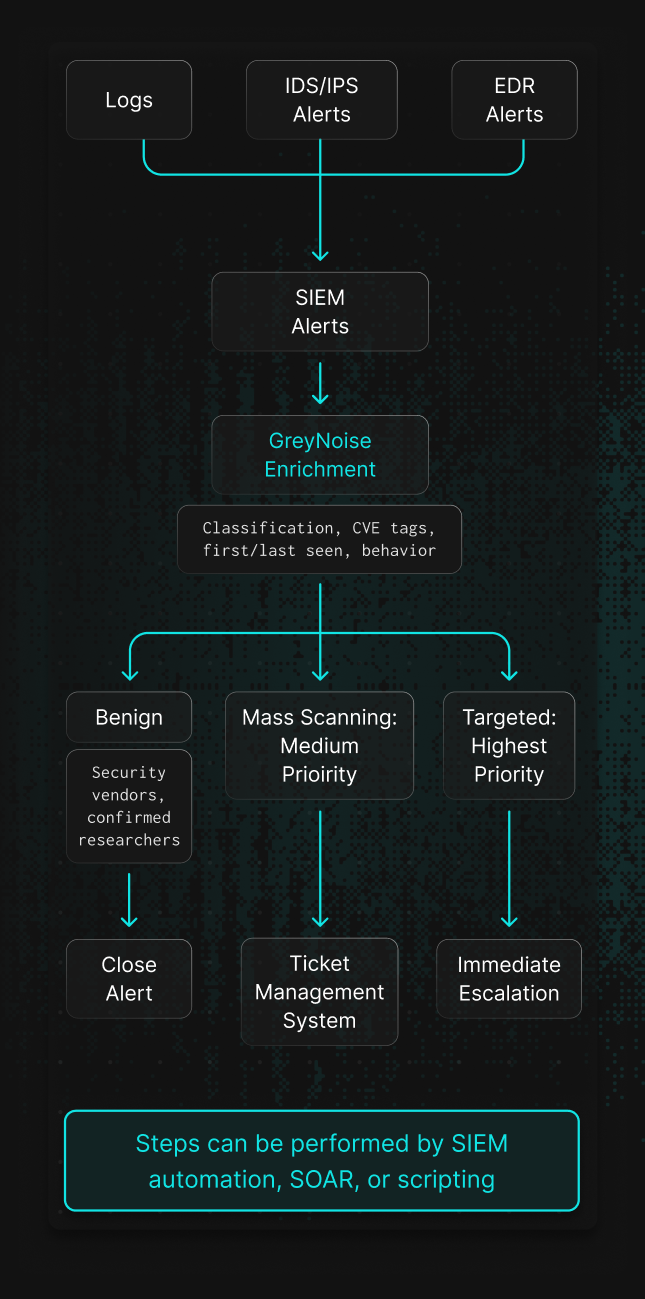
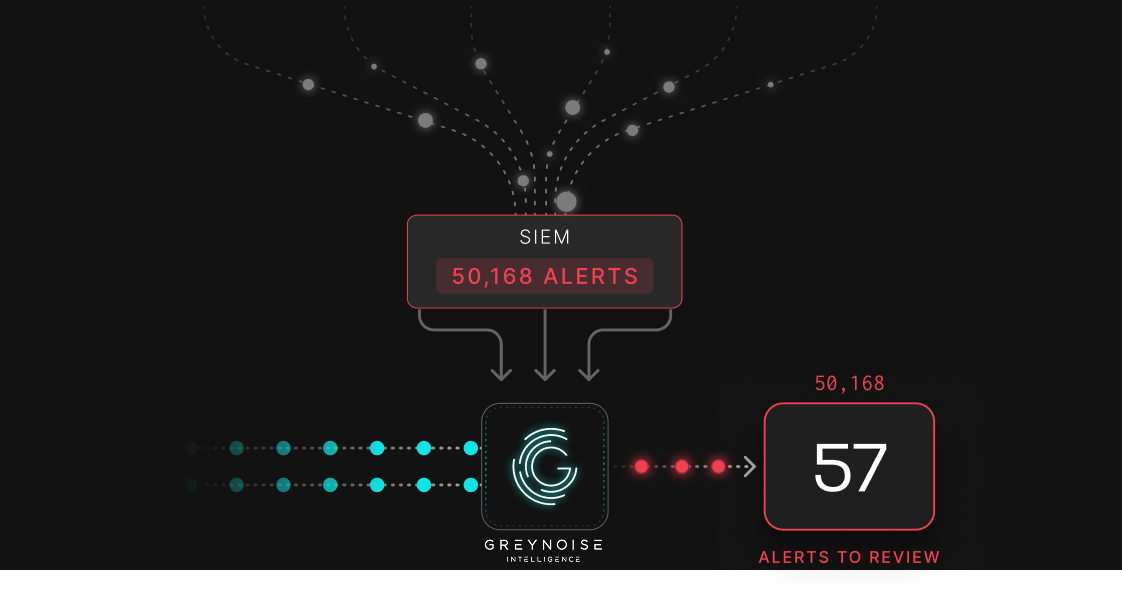
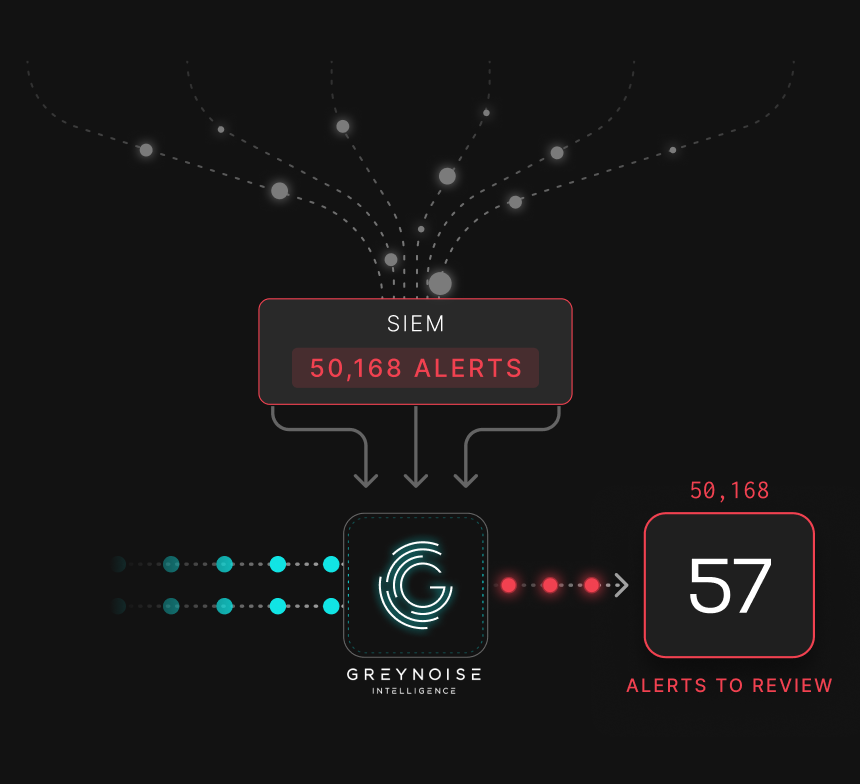
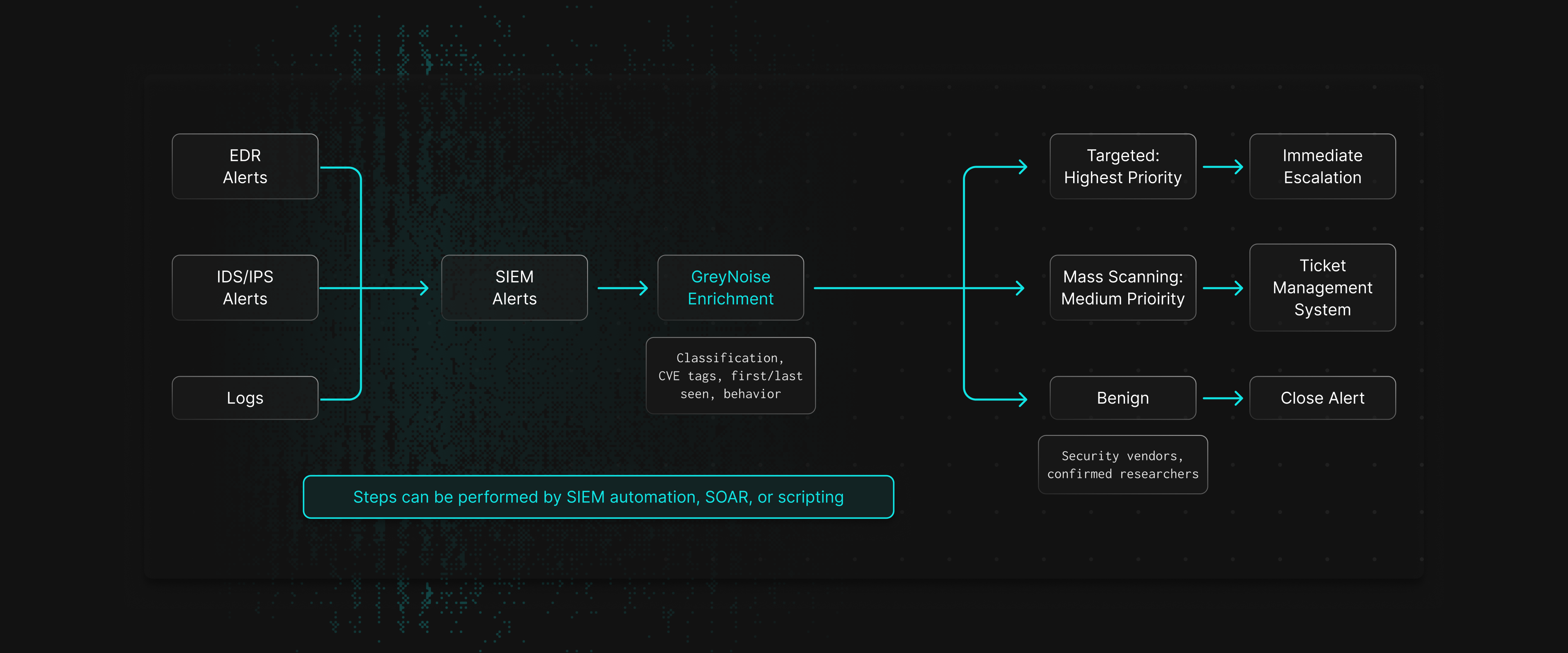
GreyNoise reduces alert fatigue by classifying IPs as benign, malicious, or suspicious. This instantly separates noise from real threats. Benign traffic can be deprioritized, malicious and suspicious activity escalated for investigation.
How GreyNoise Helps
Reduce Noise in Your SOC

Reduce Alert Fatigue

By classifying benign sources, GreyNoise eliminates noise from the alert triage queue, preventing wasted analyst time.

Escalate Confirmed Threats

Alerts tied to IPs classified as malicious—such as active exploitation, malware distribution, or botnet activity—can be automatically prioritized.

Smarter Automation

SOC playbooks can use GreyNoise classifications and tags to automate alert routing.

Block Unsolicited Scan Traffic

Use GreyNoise query-based, dynamic IP blocklists to block unsolicited scanning and reduce SOC noise.

How it Works
Explore Available Fields

Filter by category & search available IP fields and their uses with GreyNoise.
Categories
Thank you! Your submission has been received!
Oops! Something went wrong while submitting the form.
NAME
Description & Use
Source Country
Country where the IP is registered. Provides attacker infrastructure location context.
IP Address Metadata
Source Country Code
ISO country code for the IP’s registration country.
IP Address Metadata
Source Country Count
Count of IPs originating from each country. Useful for geo-distribution of attacks.
Stats & Aggregates
Spoofable
Shows whether the IP completed a valid TCP handshake. If false, traffic may be spoofed or fake.
Classification
Spoofable Count
Count of spoofable vs. non-spoofable IPs. Highlights volume of potentially fake traffic.
Stats & Aggregates
Tags Count
Count of IPs associated with specific tags. Helps identify common behaviors at scale.
Stats & Aggregates
Tor
Identifies if the IP is a Tor exit node. Tor traffic often indicates obfuscation or anonymization.
IP Address Metadata
Updated At
Date/time when the tag was last updated.
Tag Information
VPN
Flags if the IP belongs to a VPN provider. Suggests identity masking or evasive behavior.
IP Address Metadata
VPN Service
Name of the VPN service associated with the IP. Useful for attribution and filtering.
IP Address Metadata
Source Country
Country where the IP is registered. Provides attacker infrastructure location context.
IP Address Metadata
Source Country Code
ISO country code for the IP’s registration country.
IP Address Metadata
Source Country Count
Count of IPs originating from each country. Useful for geo-distribution of attacks.
Stats & Aggregates
Spoofable
Shows whether the IP completed a valid TCP handshake. If false, traffic may be spoofed or fake.
Classification
Spoofable Count
Count of spoofable vs. non-spoofable IPs. Highlights volume of potentially fake traffic.
Stats & Aggregates
Tags Count
Count of IPs associated with specific tags. Helps identify common behaviors at scale.
Stats & Aggregates
Tor
Identifies if the IP is a Tor exit node. Tor traffic often indicates obfuscation or anonymization.
IP Address Metadata
Updated At
Date/time when the tag was last updated.
Tag Information
VPN
Flags if the IP belongs to a VPN provider. Suggests identity masking or evasive behavior.
IP Address Metadata
VPN Service
Name of the VPN service associated with the IP. Useful for attribution and filtering.
IP Address Metadata