Between May 9 and May 18, 2026, GreyNoise observed a significant new spike in scanning of SonicWall SonicOS management interfaces. The May 12 peak — approximately 597,000 sessions — was the largest single-day total recorded on the SonicWall SonicOS API Scanner tag in the past 90 days, roughly 46× the typical daily volume for this tag in the 30 days before the elevation.
Similar elevations in activity against this GreyNoise tag have preceded new vulnerability disclosures affecting SonicWall (Ten Days Before Zero, GreyNoise 2026).
Activity on this tag spiked three times in an earlier sequence — on January 18, January 30, and February 14 — at 37, 25, and 10 days before the February 24 disclosure of CVE-2026-0400. The current spike may be a similar early warning.
The relationship is one observed precedent, not a rule. The current spike could be the first of a multi-event sequence like the Q1 pattern, a single event preceding a disclosure, or unrelated activity. Three documented spikes on this tag preceded a single CVE — a precedent, not an established cadence, and not a definitive rule.
GreyNoise is publishing the signal, not predicting a CVE.
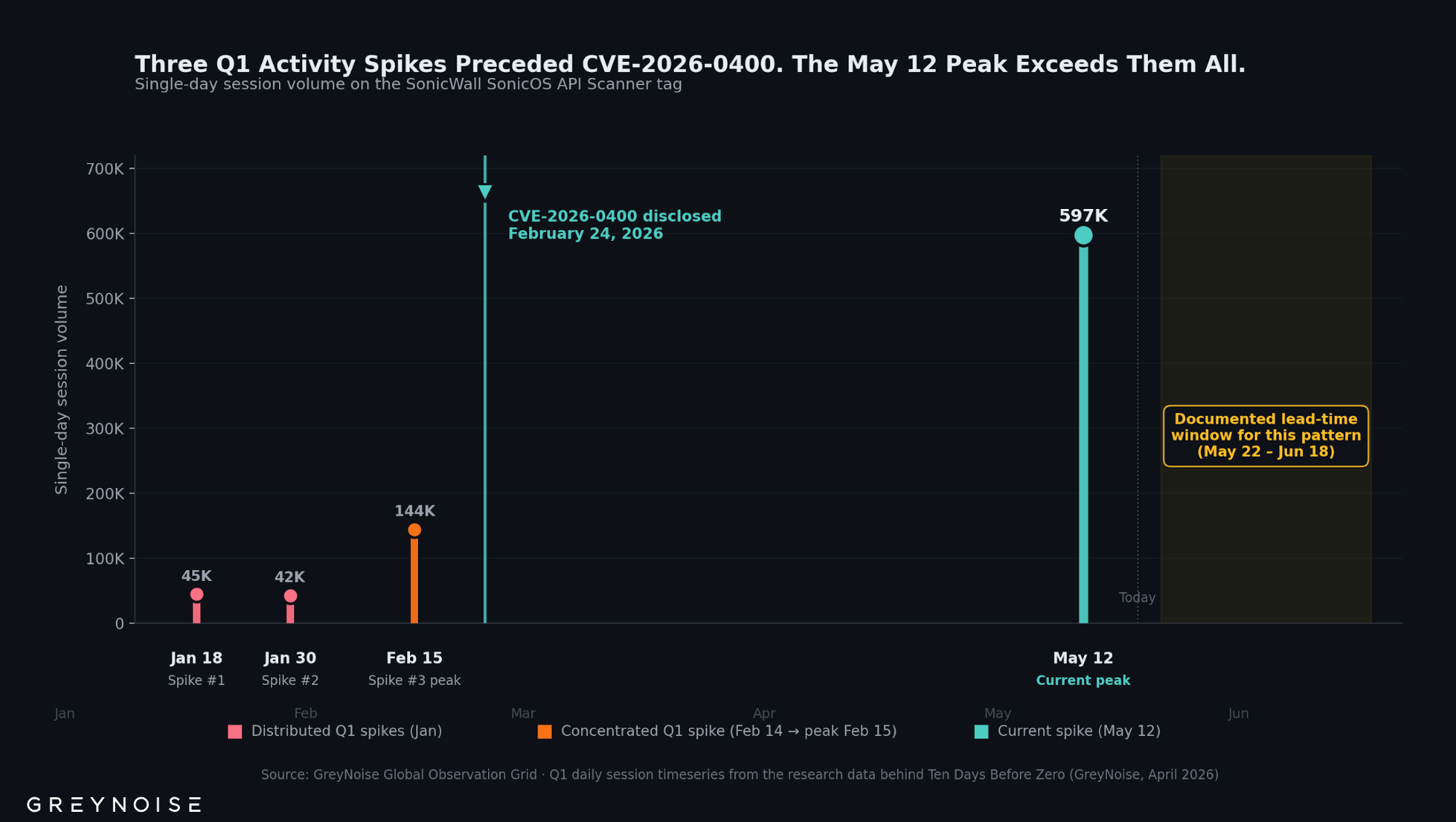
Single-day session volume on the SonicWall SonicOS API Scanner tag. Three Q1 activity spikes — January 18, January 30, and February 14, 2026 — preceded the February 24 disclosure of CVE-2026-0400. The May 12 peak is the largest single-day total recorded on this tag in the past 90 days.
What We're Seeing
- Tooling: Approximately 99% of requests carry a single browser user-agent — Chrome 119 on Linux x86_64 — the same fingerprint that dominated the January–February SonicWall scanning (94.5% of Q1 traffic, per Ten Days Before Zero). The tooling appears unchanged.
- Source infrastructure: Approximately 56% of sessions originate from networks announced in the Netherlands and 44% in Ukraine — together more than 99% of total volume.
- Concentration: A single ASN (AS211736) carries roughly half of total session volume. The IPs involved are overwhelmingly classified by GreyNoise as Suspicious.
- Targeted services: Ports 80 and 8080 (HTTP) carry virtually all the scanning.
What Defenders Should Do
Immediate:
- Restrict SonicOS management API and SSL VPN portal access to known administrative ranges. Eliminate public exposure of management interfaces.
- Require MFA on all SSL VPN accounts.
- Audit SonicOS configuration for new administrative accounts created since May 1, 2026.
- Apply a dynamic IP blocklist at the network edge.
Over the next several weeks (the documented lead-time window for this pattern):
- Monitor the SonicWall PSIRT advisory feed. Plan to patch within 24 hours of any disclosure.
- Increase logging retention and outbound-traffic alerting on SonicWall appliances.
Reference
- Ten Days Before Zero (GreyNoise, April 2026)
- SonicWall SonicOS API Scanner tag
- SonicWall SSL VPN Login Attempt tag