DETECTION & RESPONSE

Speed Up
Incident Investigations

Accelerate detection and response times with GreyNoise threat context

Overview

GreyNoise accelerates investigations by adding context on IPs and CVEs seen in mass scanning and exploitation campaigns. This enrichment speeds triage, reduces manual work, and helps SOC teams more effectively investigate timelines and the scope of incidents.
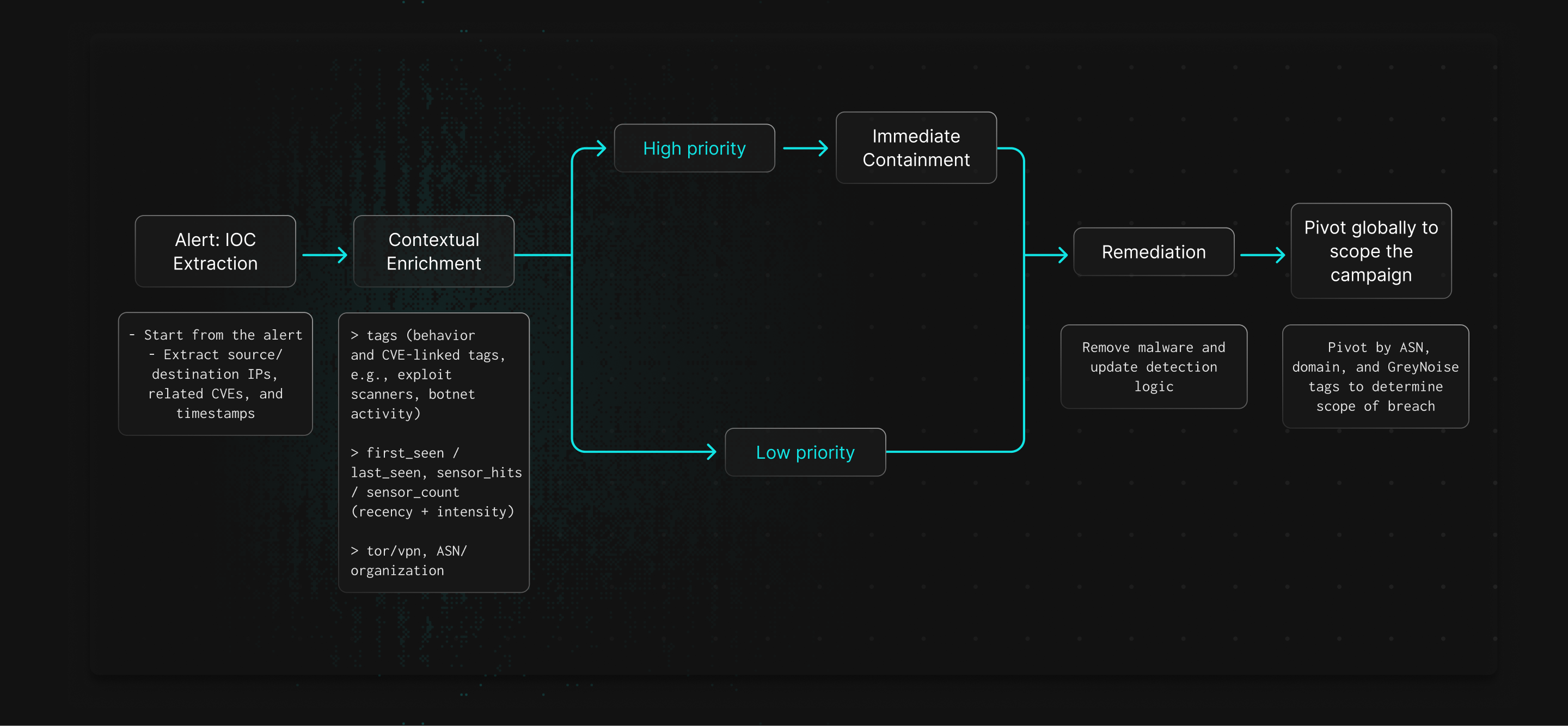
How GreyNoise Speeds Up Investigations

Enriched Threat Context

GreyNoise shows whether an IP is scanning broadly or targeting specific systems, helping analysts gauge threat levels.

Identify Exploitation Attempts

CVE tags reveal which vulnerabilities are being exploited and which assets are likely targeted.

Map Attack Infrastructure

GreyNoise links IPs, ASNs, and behaviors so analysts can pivot and see the broader campaign.

Strengthen Containment Decisions

Intelligence on attacker infrastructure helps teams decide when to block, monitor, or expand containment.

Speed Up Timeline Construction

Data on first seen, last seen, and behavior give provides evidence for accurate incident timelines.

Better Documentation and Reporting

Enriched incident reports clarify what happened and why it matters.

How it Works
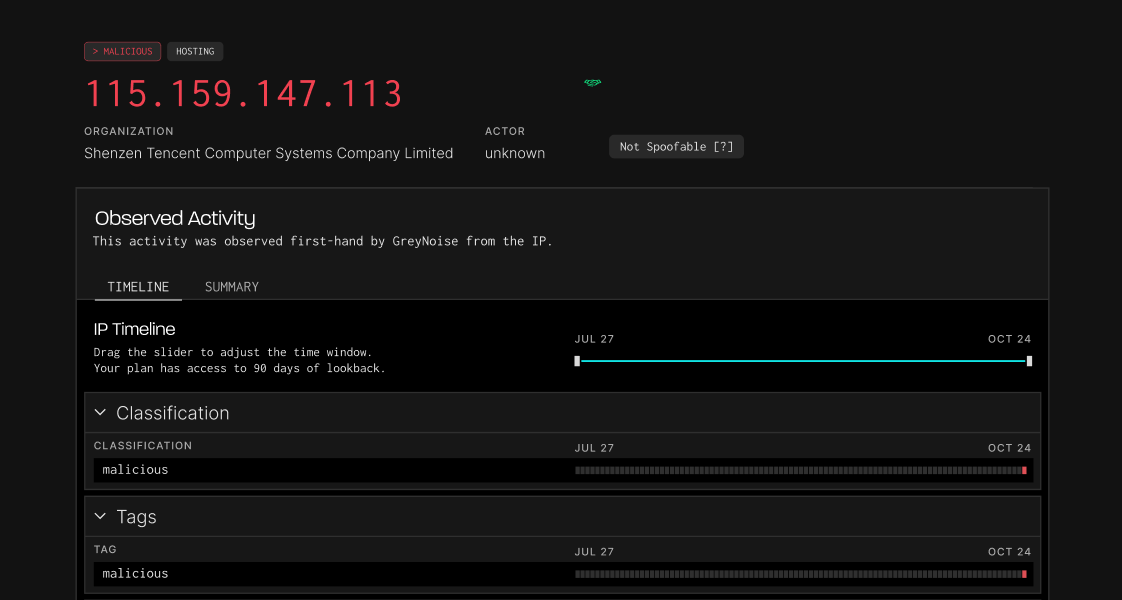
Explore Available Fields

Filter by category & search available IP fields and their uses with GreyNoise.
Categories
Thank you! Your submission has been received!
Oops! Something went wrong while submitting the form.
NAME
Description & Use
Slug
Short identifier for the tag. Useful in queries and API lookups.
Tag Information
Source Bytes
Number of bytes sent from source IP. Useful for traffic analysis.
Observed Request Data
Source Country
Country where the IP is registered. Provides attacker infrastructure location context.
IP Address Metadata
Source Country Code
ISO country code for the IP’s registration country.
IP Address Metadata
Source Country Count
Count of IPs originating from each country. Useful for geo-distribution of attacks.
Stats & Aggregates
Source Latitude
Latitude of IP’s registered location. Useful for geo-mapping.
IP Address Metadata
Source Longitude
Longitude of IP’s registered location. Useful for geo-mapping.
IP Address Metadata
Spoofable
Shows whether the IP completed a valid TCP handshake. If false, traffic may be spoofed or fake.
Classification
Spoofable Count
Count of spoofable vs. non-spoofable IPs. Highlights volume of potentially fake traffic.
Stats & Aggregates
Tags Count
Count of IPs associated with specific tags. Helps identify common behaviors at scale.
Stats & Aggregates
Timeline
Key timeline details about when the CVE was published, updated, and added to CISA (https://www.cisa.gov/known-exploited-vulnerabilities-catalog). Useful for understanding how long the issue has been known.
Timeline & Lifecycle
Timeline CISA KEV Date Added
Date the vulnerability was added to CISA’s Known Exploited Vulnerabilities (KEV) catalog. Vulnerabilities in KEV should be prioritized for remediation per federal guidance.
Timeline & Lifecycle
Timeline CVE Last Updated Date
The last date the CVE entry was updated in the database. Useful for tracking changes in severity, affected products, or exploit status.
Timeline & Lifecycle
Timeline CVE Published Date
The date the CVE was first published. Helps determine how long attackers have potentially been aware of the vulnerability.
Timeline & Lifecycle
Timeline First Known Published Date
Date when the first exploit associated with the CVE was published.
Timeline & Lifecycle
Tor
Identifies if the IP is a Tor exit node. Tor traffic often indicates obfuscation or anonymization.
IP Address Metadata
Destination Countries Count
Count of IPs targeting specific countries. Supports geo-threat monitoring.
Stats & Aggregates
Destination Country Codes
ISO codes for countries targeted by scanning. Supports correlation with geo-based IOCs.
IP Address Metadata
Details
Basic CVE details, including CVSS score (Common Vulnerability Scoring System), associated products & vendors, and NIST CVE recognition status. Provides context on the vulnerability itself.
Identification & Details
Details CVE CVSS Score
CVSS score assigned to the CVE. Commonly used in risk scoring but should be weighed alongside exploitation activity.
Identification & Details
Details Product
The product affected by the vulnerability (e.g., Apache HTTP Server). Used to match against an organization’s asset inventory for prioritization.
Identification & Details
Details Published to NIST NVD
Indicates if the vulnerability is published in the NIST National Vulnerability Database. Confirms official recognition and ensures compatibility with standard risk feeds.
Identification & Details
Details Vendor
The vendor or developer responsible for the affected product. Helps map vulnerabilities to vendor patch advisories and SLAs.
Identification & Details
Details Vulnerability Description
Summary of what the vulnerability is and how it works. Helps analysts understand potential impact and determine exploitability in their environment.
Identification & Details
Details Vulnerability Name
Human-readable name of the vulnerability. Practitioners use this for quick recognition when scanning advisories.
Identification & Details
Domain
Domain tied to the ASN owner. Provides higher-level ownership context.
IP Address Metadata
Exploitation Activity
Observed IPs scanning or exploiting the vulnerability today, in the last 10 days, and the last 30 days.
Exploitation Activity
Exploitation Activity Benign IP Count (10d)
Total number of benign IPs GreyNoise observed scanning or exploiting this vulnerability in the last 10 days.
Exploitation Activity
Exploitation Activity Benign IP Count (1d)
Total number of benign IPs GreyNoise observed scanning or exploiting this vulnerability today.
Exploitation Activity
Exploitation Activity Benign IP Count (30d)
Total number of benign IPs GreyNoise observed scanning or exploiting this vulnerability in the last 30 days.
Exploitation Activity
Exploitation Activity Seen
Whether GreyNoise has observed activity related to this CVE.
Exploitation Activity
Exploitation Activity Threat IP Count (10d)
Total number of threat IPs GreyNoise observed scanning or exploiting this vulnerability in the last 10 days.
Exploitation Activity

Cut the Noise. Close the Case.