Threat Signals

Actionable intelligence on real-world threats as they unfold. Get insights into attacker behavior, infrastructure, exploitation of zero-days and n-days, temporal pattern, and geographic hotspots — all sourced from GreyNoise’s Global Observation Grid (GOG). Stay ahead of emerging threats, block malicious IPs, and understand what’s happening in the moment.

Ghost Fleet: Half of All New Scanning IPs Last Week Geolocated to Hong Kong — Nearly None Completed a Connection

Last week, the GreyNoise Observation Grid (GOG) observed something unusual: 242,666 new scanning IPs geolocating to Hong Kong appeared in seven days — nearly half of all new scanning IPs observed by GreyNoise that week. And 99.7% of them never completed a single TCP connection.

These IPs are ghosts — they appeared in GreyNoise data but never proved they were real. Because they never completed a TCP handshake, GreyNoise cannot verify that the traffic actually originated from those addresses. They carried no payloads, triggered no detection signatures, and performed no exploitation. All they left behind were a quarter-million unverified IP addresses now sitting in observation datasets.

Geographic references throughout this post describe where IPs are registered, not where the traffic necessarily originated or where operators are located.

Here's why that matters: any detection system that observed this traffic and doesn't distinguish between verified and unverified source addresses just absorbed a quarter-million ghost IPs into its dataset. Meanwhile, the 702 IPs geolocating to Hong Kong that actually completed connections — the ones observed scanning MySQL, SSH, SMB, and RDP, hitting GOG sensors in 20+ countries — could easily get lost in the noise. One provider alone, UCLOUD, surged 472% in session volume to become the largest ASN by session volume in GreyNoise data, with 38% of its IPs classified malicious. That's the signal. The other 242,000 IPs are the noise.

On top of that, the entire scanning landscape reshuffled last week. A top ASN disappeared overnight. Traffic from IPs geolocating to Australia dropped 72%. New infrastructure geolocating to Poland and Germany appeared. The scanning sources that dominated the prior week were not the same ones that dominated last week.

Key Findings

  • 242,666 new IPs geolocating to Hong Kong — 48.9% of all new scanning IPs observed by GreyNoise last week. 99.7% never completed a TCP handshake.
  • One organization, GNET INC., contributed 143,340 IPs — 28.9% of all new IPs observed by GreyNoise. Zero were classified malicious.
  • Only 702 IPs geolocating to Hong Kong (0.3%) completed TCP handshakes. Of those, 362 are classified malicious.
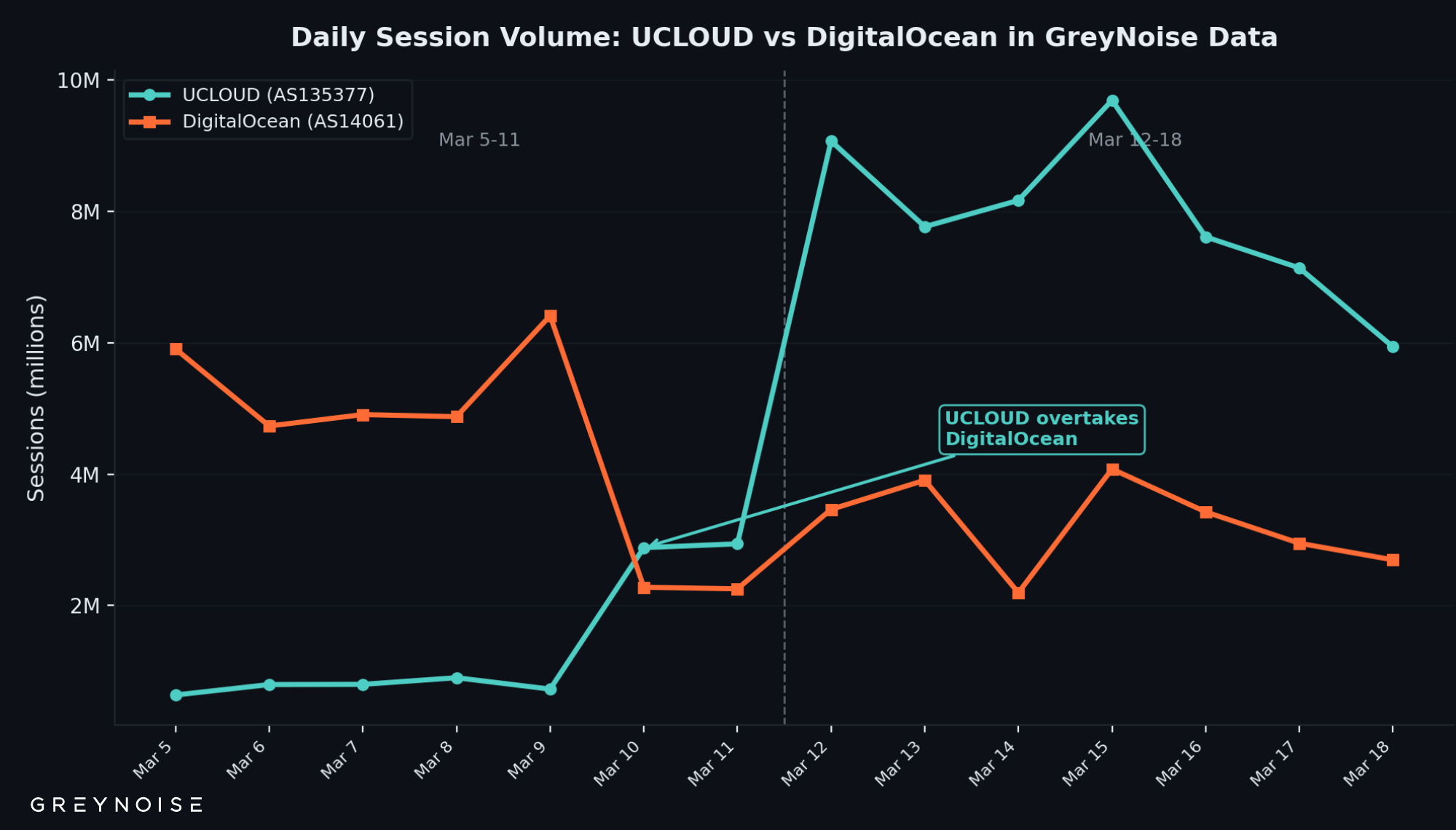
  • UCLOUD (AS135377) surged +472% in session volume, becoming the top ASN by session volume in GreyNoise data — with only 1,746 IPs but 38% classified malicious.
  • The scanning landscape rotated: a top ASN from the prior week disappeared entirely, traffic from IPs geolocating to Australia dropped 72%, and new infrastructure geolocating to Poland and Germany appeared.

The Ghost Fleet

Between March 12 and 18, GreyNoise observed 242,666 new IPs geolocating to Hong Kong — nearly equal to the rest of the world combined (253,646). Six hosting providers account for 93.3%:
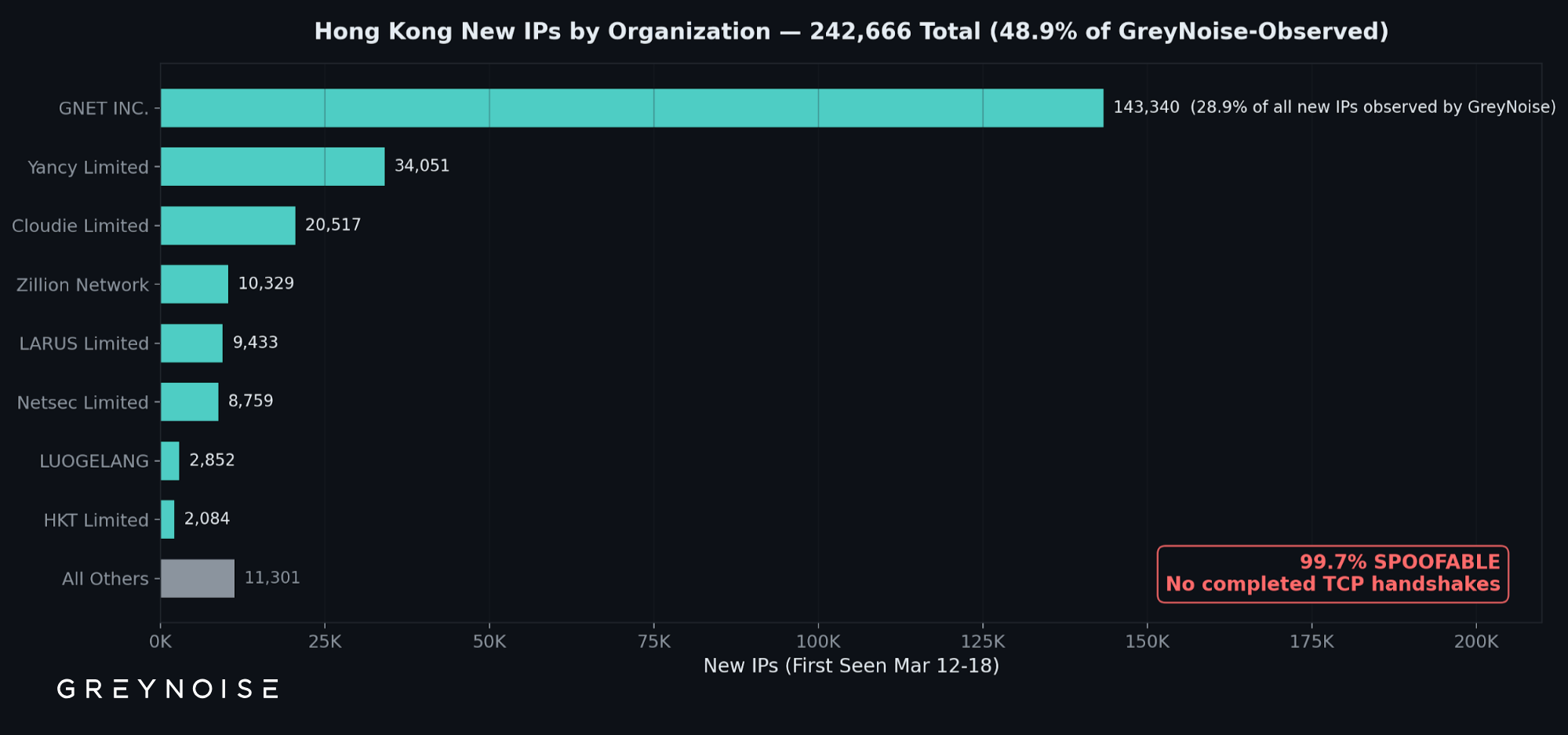
Organization ASN New IPs Spoofable Malicious Tags
GNET INC. AS9294 143,340 99.998% 0 Virtually none
Yancy Limited AS138415 34,051 99.998% 1 Virtually none
Cloudie Limited AS55933 20,517 99.91% 45 Minimal
Zillion Network Inc. AS54801 10,329
LARUS Limited AS17561 9,433 100% 0 None
Netsec Limited AS45753 8,759 99.96% 1 Minimal

Figure 1: New IPs geolocating to Hong Kong, by organization. GNET INC. alone contributed 28.9% of all new IPs observed by GreyNoise.

When GreyNoise labels an IP "spoofable," it means the IP was observed sending traffic but never completed a TCP three-way handshake — the source address is unverified. Of these 242,666 IPs, 241,964 are spoofable. They are classified "unknown," categorized as "hosting" infrastructure (92.3%), and carry almost no GreyNoise tags.

One Organization, 143,340 IPs, Zero Malicious

GNET INC. (AS9294) is the single largest contributor — one organization that added 28.9% of all new IPs observed by GreyNoise in a single week:

Metric Value
Total active IPs (including pre-existing) 163,051
Spoofable 99.998% (only 3 completed TCP handshakes)
Classification 100% unknown
Malicious IPs 0
GOG sensor countries reached Primarily United States
Tags QUIC Protocol on 30 IPs. Nothing else.

No exploitation. No brute-force activity. No web crawling. Incomplete connections only.

Names That Don't Match Registration Geography

Several ghost fleet entities are registered under names that don't align with where their IPs geolocate:

Entity ASN Total IPs Discrepancy
LUOGELANG (FRANCE) LIMITED AS135097 62,617 "France" in name — 0% of IPs geolocate to France (62% HK, 38% US)
LARUS Limited AS17561 19,687 Split between Hong Kong (9,832) and Russia (8,751)
Taiwan Li Run Ltd AS131147 5,119 "Taiwan" in name — 4,096 IPs geolocate to mainland China, 1,023 to Hong Kong

The Signal Behind the Noise: UCLOUD

The ghost fleet is the noise. The signal is UCLOUD (AS135377).
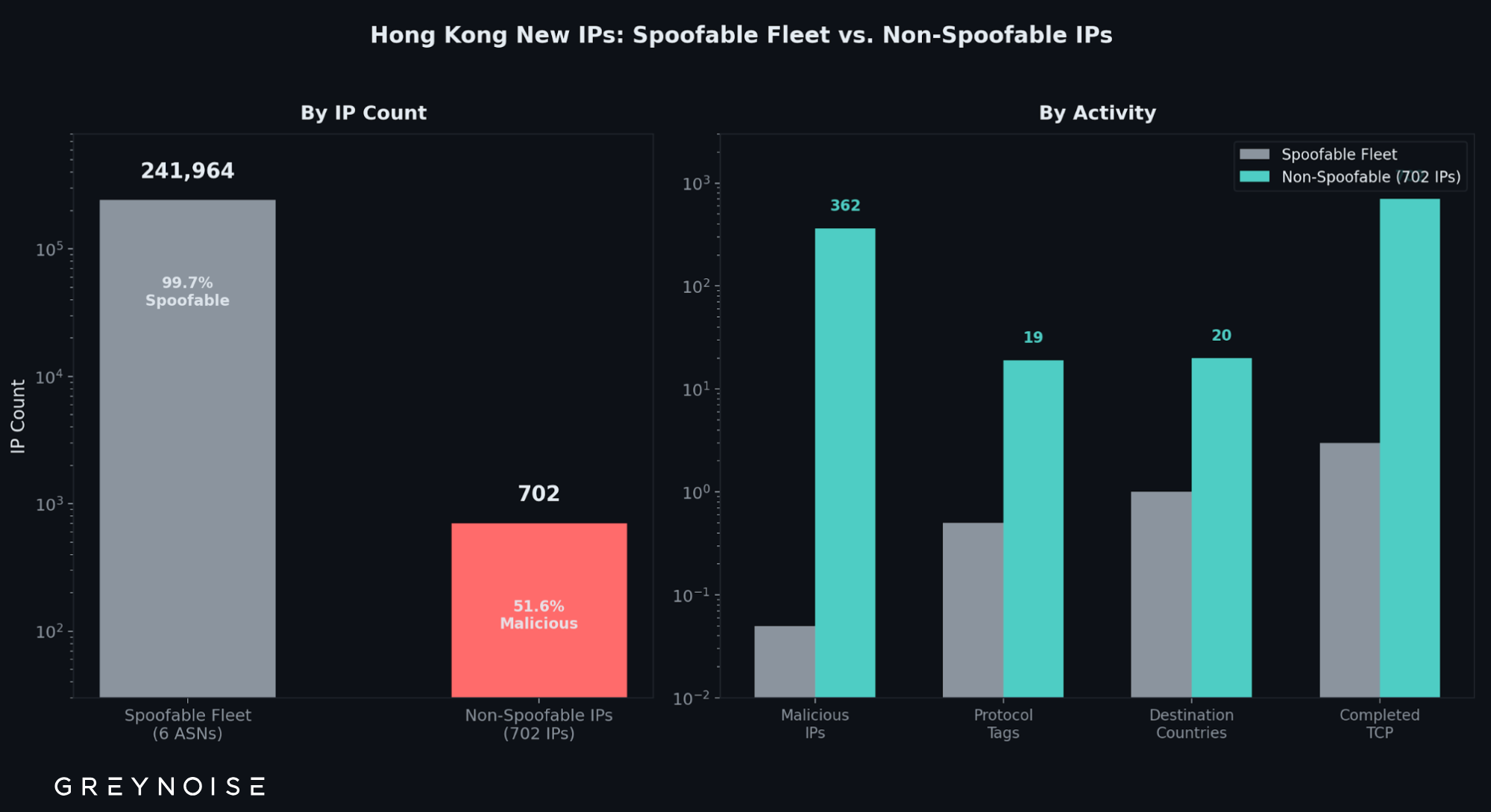
Spoofable vs. non-spoofable IPs geolocating to Hong Kong — 242,000 IPs that did not complete TCP handshakes vs. 702 that did.

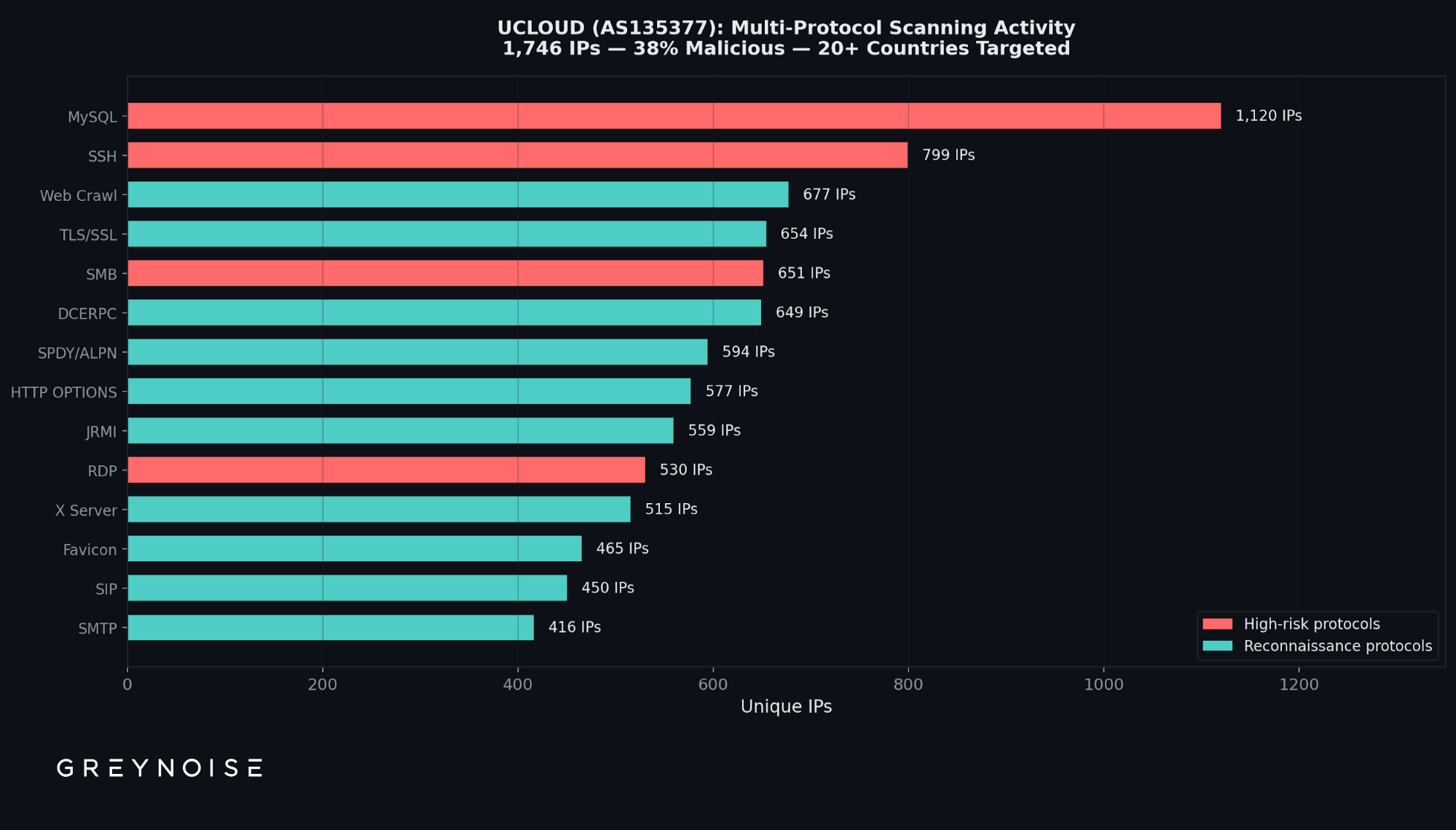
UCLOUD contributes just 1,746 IPs — 0.4% of the active IPs geolocating to Hong Kong in GreyNoise data. But it accounts for an outsized share of observed scanning and exploitation attempts:
Metric UCLOUD (AS135377) Spoofable Fleet Average
New IPs 1,746 8,759 to 143,340 per ASN
Malicious classification 38% (663 IPs) <0.1%
Spoofable 43.5% >99.9%
GOG sensor countries reached 20+ Primarily 1 (US, 99.8%)
Unique protocol tags 14+ active tags 0-2 tags

Figure 3: UCLOUD multi-protocol scanning activity observed by GreyNoise, spanning 14+ protocols.

The contrast is stark. The entity generating 82x more IPs (GNET INC.) has zero classified malicious. The entity generating 82x fewer IPs (UCLOUD) has 663 — observed scanning MySQL, SSH, SMB, and RDP, with traffic reaching GOG sensors in more than 20 countries.

The Volume Surge

UCLOUD's session volume went from 9.7 million to 55.4 million in one week — displacing DigitalOcean as the top ASN by session volume in GreyNoise data:
Week UCLOUD Sessions DigitalOcean Sessions UCLOUD Rank
Mar 5-11 9,679,761 31,361,945 #3
Mar 12-18 55,384,799 22,709,383 #1
Change +472% -27.6%

Figure 4: Daily session counts showing UCLOUD overtaking DigitalOcean as the top ASN by session volume in GreyNoise data.

The Rotation: Everything Shifted in Seven Days

The ghost fleet wasn't the only change. The entire scanning landscape observed by GreyNoise reshuffled. AS213438, a top ASN the prior week with 10.7 million sessions, disappeared entirely — an abrupt shutoff consistent with infrastructure being decommissioned or rotated.

What declined (source refers to IP geolocation; destination refers to GOG sensor location):
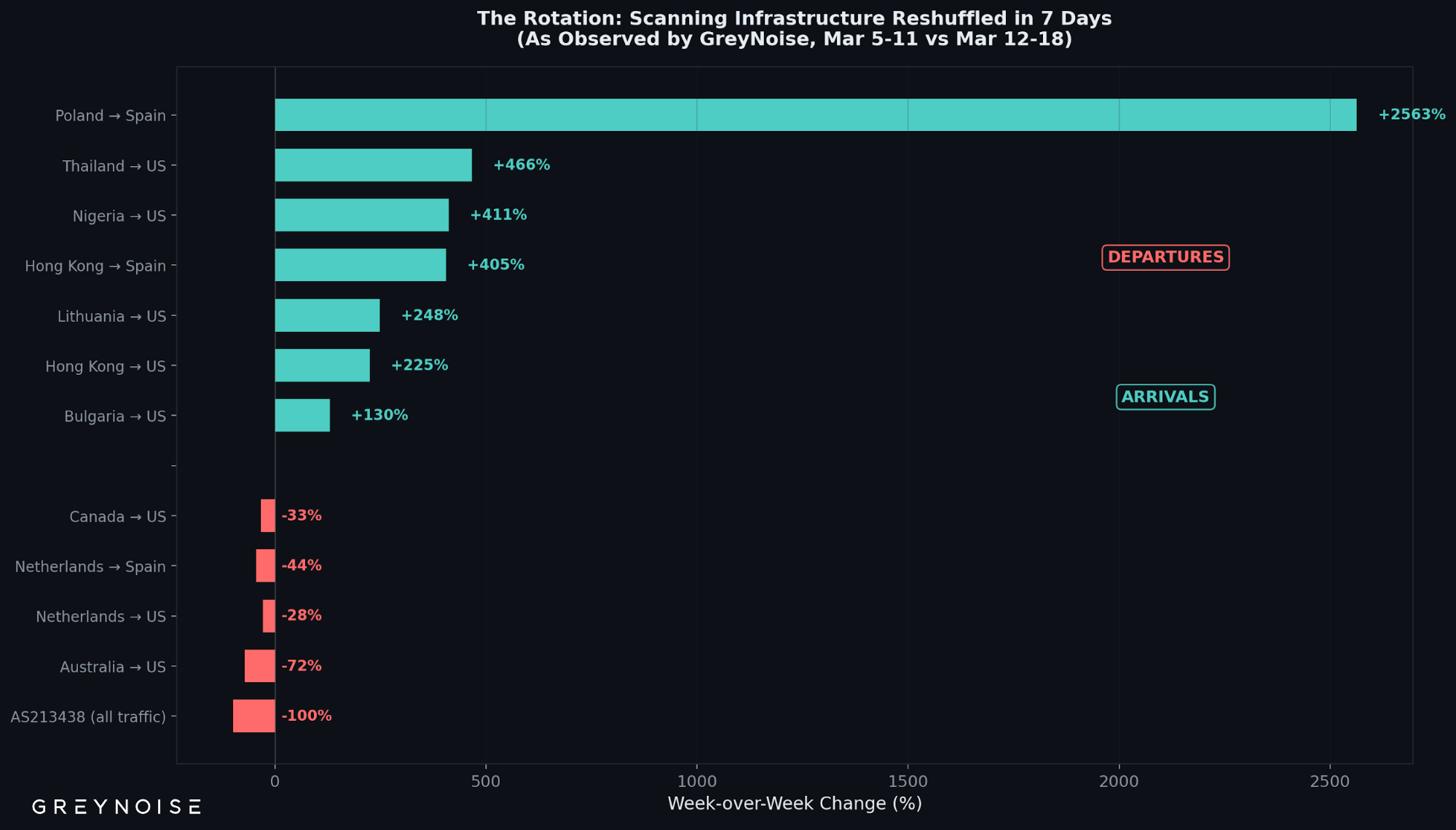
Source (by IP geolocation) Mar 5-11 Mar 12-18 Change
Australia to US 4,109,617 sessions 1,153,593 -71.9%
Netherlands to US 17,886,273 12,952,923 -27.6%
Netherlands to Spain 5,540,230 3,112,579 -43.8%
Canada to US 3,649,150 2,454,528 -32.7%

What appeared (source refers to IP geolocation; destination refers to GOG sensor location):

Source (by IP geolocation) Mar 5-11 Mar 12-18 Change
Hong Kong to US 4,744,912 15,427,214 +225%
Poland to Spain 312,708 8,325,850 +2,563%
Hong Kong to Spain 1,410,537 7,117,338 +405%
Thailand to US 966,313 5,468,241 +466%
Nigeria to US 559,975 2,863,781 +411%
Lithuania to US 1,523,952 5,300,605 +248%
Bulgaria to US 1,496,734 3,444,281 +130%

Figure 5: Week-over-week changes in scanning traffic by source-destination pair, as observed by GreyNoise.

Under the Hood

Cross-referencing GreyNoise observations with Censys internet-wide scan data and VirusTotal reputation data reveals infrastructure patterns not visible from any single source.

Templated deployment across borders.

A cluster on infrastructure geolocating to Germany, registered to a Seychelles entity, shows configurations consistent with deployment from a single VM image. A separate Windows VPS cluster uses IPs geolocating to Bulgaria, Romania, and France across three ASNs with an identical service configuration on each node — scanning infrastructure deployed from a common template.

UCLOUD relay infrastructure.

Censys data reveals purpose-built traffic relay and tunneling software deployed across UCLOUD at a density not typical of legitimate hosting. Repeating non-standard port configurations appear identically across multiple subnets — the signature of a single VM template deployed at scale.

Low reputation detection.

The top scanning IPs are barely flagged:

IP Provider Vendor Detections Notable
109.205.211[.]101 MEVSPACE / Colocatel Inc. (AS201814) 2 of 94 Zero communicating files. 7.97M sessions/week. IPs geolocate to Poland; registered to Colocatel Inc. (Seychelles).
79.124.58[.]146 Tamatiya EOOD (AS50360) 5 of 94 IPs geolocate to Bulgaria. Self-signed SSL cert: localhost.localdomain by "VMware Installer"
91.238.181[.]10 Fbw Networks SAS (AS49434) 7 of 94 IPs geolocate to France. Communicating file: mssecsvr.exe (Win32, first seen 2018). Malicious history predating current activity.

What We Don't Know

GreyNoise cannot determine the purpose of the ghost fleet from GreyNoise data alone. Censys confirms these ASNs are active hosting ecosystems — the spoofable traffic uses source addresses in IP ranges distinct from the legitimate hosted infrastructure. What we can say: 242,666 IPs appeared, almost none completed connections, and the source addresses are unverified.

What Defenders Should Do

  • Detection stacks that don't distinguish spoofable IPs from confirmed scanners may be affected. 242,666 unverified source addresses now exist in observation datasets. Systems that weight activity by IP count without verifying connections should be reviewed.
  • Update blocklists. The sources that dominated scanning the prior week declined or disappeared, replaced by infrastructure geolocating to Hong Kong, Poland, and Germany — all within seven days.
  • Monitor UCLOUD (AS135377). GreyNoise observed multi-protocol scanning activity targeting MySQL (3306), SSH (22), SMB (445), and RDP (3389).
  • Track the ghost fleet ASNs for behavioral changes: AS9294, AS138415, AS55933, AS135097, AS17561, AS45753. If these IPs begin completing TCP handshakes and deploying payloads, the assessment changes.

GreyNoise is not attributing this activity to a named threat actor or state sponsor. The geographic references in this post describe where IPs are registered, not necessarily where the operators are located. Hosting infrastructure is routinely used by actors with no geographic connection to the provider's registration.

Thank you! Your submission has been received!
Oops! Something went wrong while submitting the form.

Log4j Analysis - What to Do Before the Next Big One

Over the past month, security teams have been scrambling to deal with the fallout from the Log4Shell vulnerability (CVE-2021-44228) announced in early December. Between blocking exploitation attempts and trying to determine vulnerable assets, it had already been a long winter for defenders. This vulnerability is particularly challenging as the Apache Log4j library has been used within so many different applications worldwide that it created an unusually large surface area for security teams to identify and defend. Now that the initial shock of the vulnerability is over, we wanted to answer some questions received during the exploit surge and identify a few preventative strategies that might help during future outbreaks.

What does scanning for Log4J look like now?

GreyNoise-log4j-chart-data-December-January
Figure 1: Log4j-related activity from December 10, 2021, to Jan 12, 2022. ‘Attributable’ activity describes individuals or organizations that voluntarily provided self-attribution while scanning for Log4j

As of January 2022, a month after initial CVE announcement, GreyNoise still observes a significant volume of traffic related to the Log4j vulnerability. This traffic is primarily composed of generic JNDI string exploit attempts with known obfuscations.

One of the interesting patterns we saw during the first few days of the Log4j “scan-and-exploit” outbreak was a huge surge in benign actors scanning for the vulnerability. The chart above shows Log4j-related activity broken down by scanners who provided attribution (generally benign scanning done by security firms, researchers, and academics) compared to non-attributed scanning (generally, malicious scanning by threat actors).

A huge part of the surge in scanning activity during the first days of the outbreak can be attributed to benign actors. Within the security community, there is significant discussion about the appropriateness of this scanning volume, as security teams further struggled with the alert volumes generated by this traffic during an emergent situation. It’s controversial enough that some in the security community are advocating blocking these types of scans.

Should I block the IPs that are scanning?

That depends. GreyNoise tracks internet noise caused by IPs scanning the entire internet, and classifies them as malicious, unknown, or benign based on their behavior and identity. For example, security vendors that scan the internet to identify vulnerable systems who voluntarily provide self-attribution are generally classified as benign. Other IP addresses that do opportunistic or unsolicited scanning, vuln checking, or exploitation are generally classified as malicious.

Note that organizations are not obligated to allow scanning of their network perimeter, regardless of GreyNoise classification. The value added by allowing or not blocking any IP seen by GreyNoise will vary depending on an organization’s threat model and security posture. The intended purpose of most benign traffic observed by GreyNoise is often to provide context, awareness, and added value to the IT and InfoSec community. However, any significant volume of unsolicited traffic, even that classified as benign by GreyNoise, may result in SOC alert fatigue and dangerous distraction during an active attack.

Does the GreyNoise tag capture the newest versions/latest associated vulnerabilities?

Mostly. The GreyNoise Log4J tag utilizes the presence of a JNDI format string within a packet’s body to tag IPs. The tag focuses on the core cause of the Log4j vulnerability, common to all the CVEs related to Log4j (CVE-2021-44228, CVE-2021-45046, CVE-2021-45105, CVE-2021-44832). As a result, the GreyNoise tag has no false positives and provides substantial coverage for relevant CVEs.

However, GreyNoise researchers have observed at least two examples of attempted Log4j exploits where the malicious string was base64 encoded in an application-specific parameter, allowing it to circumvent the GreyNoise tag.

See the following for more details: https://gist.github.com/nathanqthai/197b6084a05690fdebf96ed34ae84305#base64-encoded-into-parameter

Can I get payload data? Pcap?

Not usually. GreyNoise does not currently provide raw sensor data for operational security purposes, although we may do so in the future. The GreyNoise Visualizer and APIs do expose select User-agents and URI paths.

That said, due to the high variance of payloads observed at the peak of Log4j activity in December 2021, GreyNoise researchers elected to curate and publish a unified list of payload examples:

https://gist.github.com/nathanqthai/197b6084a05690fdebf96ed34ae84305#base64-encoded-into-parameter

What’s next?

Application-specific attacks leveraging Log4j vulnerabilities. This Apache Log4j vulnerability has been extremely challenging due to the ubiquity of the logging library's use. CVE-2021-44228 had an enormous impact and drew significant attention to how the Log4j library was used within applications worldwide. This attention resulted in several follow-on CVEs that bypassed the initial patch and used varied attack vectors (CVE-2021-45046, CVE-2021-45105, CVE-2021-44832). Log4j-related exploit activity may evolve as security researchers continue to scrutinize the library and its usage across various applications. For example, application-specific vulnerabilities like those discovered in H2 Database Console and VMware may become more prevalent. (https://portswigger.net/daily-swig/researchers-discover-log4j-like-flaw-in-h2-database-console, https://www.vmware.com/security/advisories/VMSA-2021-0028.html) At this time, GreyNoise has not observed any notable trends or upticks regarding application-specific Log4j payloads.

There are more servers on the internet than there is IPv4 space to assign each of these servers a unique address. In the case of the HTTP protocol, hundreds of servers may share a singular IP address and only be reachable when a specific host header is set as part of the connection request. Scoping out this much larger section of the internet in relation to Log4j is a non-trivial task that remains to be fully explored. It is also one of the reasons the cyber defense search engine “Onyphe” opted against scanning the entire internet for vulnerabilities related to Log4j and instead opted for a more targeted approach.

Stay tuned to GreyNoise to help identify exploit outbreaks

While things are not as bad as they were in December 2021, we do not envision Log4j scanners and attackers disappearing anytime soon. At GreyNoise, our goal is to help identify these kinds of outbreaks as fast as we possibly can in order to give security teams the time and breathing space they need to get their defenses in place.

You are always welcome to use the GreyNoise product to help you separate internet noise from threats as an unauthenticated user on our site. For additional functionality and IP search capacity, create your own GreyNoise Community (free) account today.

Trending Internet Scanning on Apache Log4j Vulnerability

Exploit activity for Apache Log4j vulnerability - CVE-2021-44228

UPDATE 16-Dec-21, 4:00 PM ET: Tentative results for #Log4Shell activity by hour showing "Researcher" and "Non-Researcher" breakdown as observed by GreyNoise. It may not be 100% accurate, but it should give an idea of what we are observing. "Researcher" is defined by IPs that GreyNoise knows to be attributable scanners for commercial or research purposes, usually listed as "benign" in our data. "Non-Researcher" is defined as everything else. The researcher numbers seem to flatline, but we believe this is due to the scale of the plot, and new infrastructure spun up by various researchers that have not yet been accounted for. We will try to update this later for a better retroactive understanding.

UPDATE 16-Dec-21, 1:00 PM ET: GreyNoise Research has compiled a set of sample Log4Shell (CVE-2021-44228) payloads observed in the wild. These samples are intended to provide individuals with a clearer idea of some of the variation we're seeing, including esoteric protocols such as IIOP. https://gist.github.com/nathanqthai/197b6084a05690fdebf96ed34ae84305

UPDATE 15-Dec-21, 11:00 PM ET: As of 15-Dec-21, GreyNoise Research is seeing a decrease in the number of unique IP addresses scanning for the Apache Log4j vulnerability.

Figure: Log4Shell Unique IPs per hour, Source: GreyNoise Research

On December 5, 2021, Apache identified a vulnerability (later identified as CVE-2021-44228) in their widely used Log4j logging service. The vulnerability, also known as Log4shell, enables attackers to gain full control of affected servers by allowing unauthenticated remote code execution if the user is running an application utilizing the Java logging library. Log4j is heavily integrated into a broad set of DevOps frameworks, enterprise IT systems, and vendor software and cloud products.

GreyNoise first observed activity for this vulnerability on December 9, 2021, from 194.48.199[.]78 and 181.214.39[.]2.

Source: GreyNoise Research, Twitter (https://twitter.com/_mattata/status/1469144854672379905)

To get a current list of all the IP addresses opportunistically scanning the internet to vuln check or exploit CVE-2021-44228, check out this tag summary in the GreyNoise Visualizer

“The reason this vulnerability matters is that Log4j is heavily integrated in enterprise IT and devops. There are a whole bunch of devops frameworks and a whole bunch of enterprise IT systems and vendor systems that use it. So if you pick basically any large vendor and stick Log4j in Google, you’ll find it kicking around in different products, which is going to become a problem. There’s clearly lots of systems out there that, in some way shape or form, rely on this.” – Kevin Beaumont (@GossiTheDog, via Twitter Spaces recording)

Timeline of CVE-2021-44228

On December 5th, 2021, Apache filed a JIRA issue identifying the vulnerability that would become CVE-2021-44228. The following day, December 6th, Apache released a patch providing some details on the vulnerability and crediting Chen Zhaojun of Alibaba Cloud Security Team for the discovery.

On December 9th, weaponized proof-of-concept exploits (PoCs) began to appear, leading to a rapid increase of scanning and public exploitation on December 10th.

Figure: Timeline of events leading up to GreyNoise observing CVE-2021-44228 in the wild. Source: GreyNoise Research

Between 1200 EST and 1400 EST on December 10, 2021, GreyNoise has observed a 5x increase in the number of hits per sensor related to the Log4shell event.

Figure: Hourly breakdown of traffic observed by GreyNoise sensors on 2021-12-09 to 2021-12-10. Source: GreyNoise Research

Impact of CVE-2021-44228

Due to ease of exploitation and prevalence of Log4J, GreyNoise researchers believe that this activity will continue to increase over the next few days. A wide variety of use cases for this exploit have already begun to appear, ranging from exploiting Minecraft servers

Figure: Exploiting Minecraft servers with the Apache Log4j vulnerability. Source: https://twitter.com/twokilohertz/status/1469087293126365186

to more high-profile issues potentially affecting Apple iCloud

Figure: Exploiting Apple iCloud with the Apache Log4j vulnerability. Source: https://twitter.com/GossiTheDog/status/1469344690336108544

The vulnerability feels similar to ShellShock, a vulnerability GreyNoise still observes since it was first identified in 2014.

Indicator of Compromise (IoC) resources for security teams

GreyNoise is providing IOCs for CVE-2021-44228 Apache Log4j RCE attempts on Github. You can access the C2/Callback domains here and the latest IPs here. You can get the most up-to-date information via GreyNoise for Log4shell here.

Figure: GreyNoise IOCs for CVE-2021-44228 Apache Log4j RCE attempts - C2/Callback domains. Source: GreyNoise Research

CVE-2021-44228 is still new, and its impact will likely be felt for a long time due to the pervasiveness of Log4j. Multiple recommendations for patching have been made (CISA), and detections have been made available. As the landscape develops, GreyNoise will be tweeting about new information and IoCs. Follow us there for the latest information.

Get Started With GreyNoise For Free

GreyNoise Tag Round Up | October 1 - 29

New Tags

GitLab CE RCE Attempt  [Intention: Malicious]

Apache Storm Supervisor RCE Attempt  [Intention: Malicious]

  • CVE-2021-40865
  • This IP address has been observed attempting to exploit CVE-2021-40865, a pre-auth remote code execution vulnerability in Apache Storm supervisor server.
  • Sources: Security Lab, SecLists
  • See it on GreyNoise Viz

Hikvision IP Camera RCE Attempt  [Intention: Malicious]

  • CVE-2021-36260
  • This IP address has been observed attempting to exploit CVE-2021-36260, a remote command execution vulnerability in Hikvision IP cameras and NVR firmware.
  • Sources: Watchful IP, Github (@Aiminsun)
  • See it on GreyNoise Viz

SonicWall SMA100 Factory Reset Attempt  [Intention: Malicious]

  • CVE-2021-20034
  • This IP address has been observed attempting to exploit CVE-2021-20034, an arbitrary file deletion vulnerability that allows performing a factory reset on SonicWall SMA100 devices.
  • Sources: Exploit DB, Attacker KB
  • See it on GreyNoise Viz

SonicWall SSL-VPN RCE Attempt  [Intention: Malicious]

  • This IP address has been observed attempting to exploit a remote command execution vulnerability in SonicWall SSL-VPN.
  • Sources: Darren Martyn (GitHub)
  • See it on GreyNoise Viz

Legacy Web Server RCE Attempt [Intention: Malicious]

  • CVE-2009-4487, CVE-2009-4488, CVE-2009-4489, CVE-2009-4490, CVE-2009-4491, CVE-2009-4492, CVE-2009-4493, CVE-2009-4494, CVE-2009-4495, CVE-2009-4496
  • This IP address has been observed attempting to exploit a command injection vulnerability found in the old versions of several web servers.
  • Sources: ush.it
  • See it on GreyNoise Viz

D-Link DIR-825 R1 RCE Attempt [Intention: Malicious]

  • CVE-2020-29557
  • This IP address has been observed attempting to exploit CVE-2020-29557, a remote command execution vulnerability in D-Link DIR-825 R1 devices.
  • Sources: Shaked Delarea, NIST
  • See it on GreyNoise Viz

D-Link DNS-320 RCE Attempt [Intention: Malicious]

  • CVE-2020-25506
  • This IP address has been observed attempting to exploit CVE-2020-25506, a remote command execution vulnerability in D-Link DNS-320 devices.
  • Sources: NIST, GitHub
  • See it on GreyNoise Viz

Micro Focus OBR RCE Attempt [Intention: Malicious]

  • CVE-2021-22502
  • This IP address has been observed attempting to exploit CVE-2021-22502, a remote command execution vulnerability in Micro Focus Operation Bridge Reporter software.
  • Sources: NIST, GitHub
  • See it on GreyNoise Viz

Yealink Device Management RCE Attempt [Intention: Malicious]

  • CVE-2021-27561
  • This IP address has been observed attempting to exploit CVE-2021-27561, a remote command execution vulnerability in Yealink Device Management Platform.
  • Sources: NIST,  SSD Disclosure
  • See it on GreyNoise Viz

A Patchy Server: GreyNoise observes Path Traversal and Remote Code Execution in Apache HTTP Server (CVE-2021-41773)

Path Traversal and Remote Code Execution in Apache HTTP Server, CVE-2021-41773

On October 4th, 2021, Apache disclosed a path traversal vulnerability CVE-2021-41773 that affects HTTP Server version 2.4.49. The vulnerability was introduced in this version (2.4.49) and is patched in version 2.4.50.

This path traversal vulnerability allows sensitive files outside of the expected document root to be accessed, such as configuration files and Common Gateway Interface (CGI) scripts. This allows for specially crafted requests to read arbitrary files as well as perform Remote Code Execution (RCE) on systems that have the Apache “mod_cgi” module enabled.

Figure 1: GreyNoise Timeline of CVE-2021-41773
Figure 1: GreyNoise Timeline of CVE-2021-41773GreyNoise Intelligence

On October 3rd, 2021, at 08:44 UTC, GreyNoise observed the first scan for this vulnerability from 36.68.53.196. This predates the mailing list announcement from Apache on October 5th as well as the release of 2.4.50 on October 4th, but after the patch was committed on September 29th. [View 36.68.53.196 in GreyNoise]

Figure 2: GreyNoise sensors observed scanning activity prior to vulnerability disclosure.

As of October 5th, 2021, the first Proof of Concept (POC) code became available which demonstrated arbitrary file read. It was closely followed by a POC demonstrating RCE.

Figure 1: Count of CVE-2021-41773 Attempts by Day
Figure 2: Count of CVE-2021-41773 Attempts by Day

GreyNoise Tag for CVE-2021-41773

GreyNoise has released the following tag to enable monitoring of relevant activity:

As of 7-Oct-21, GreyNoise is seeing 47 unique IP addresses that have scanned for this vulnerability, 39 of which are “malicious” and 8 of which are “benign."

Figure 3: GreyNoise Visualizer page showing all IP addresses scanning for CVE-2021-41773, data pulled on Oct. 7, 2021

* Editor’s Note: If this tag returns “No results found’,' this means that GreyNoise has not observed any IP addresses scanning the internet for this CVE in the past 90 days. You can use GreyNoise to notify you if this changes by using our Alerts feature.

10/15/21: This blog has been updated with Figure 1 to depict the timeline of events.

GreyNoise Tag Round Up | September 14 - 30

New Tags

Azure OMI RCE Attempt  [Intention: Malicious]

  • CVE-2021-38647, CVE-2021-38648, CVE-2021-38645, CVE-2021-38649
  • This IP address has been observed scanning the internet for WSMan Powershell providers without an Authorization header, a root RCE in Azure Open Management Infrastructure.
  • Sources: Wiz, Microsoft Security Response Center [1, 2, 3, 4]
  • See it on GreyNoise Viz

Azure OMI RCE Check [Intention: Unknown]

  • CVE-2021-38647, CVE-2021-38648, CVE-2021-38645, CVE-2021-38649
  • This IP address has been observed scanning the internet for WSMan Powershell providers without an Authorization header, but has not provided a valid SOAP XML Envelope payload.
  • Sources: Wiz, Microsoft Security Response Center [1, 2, 3, 4]
  • See it on GreyNoise Viz

VMWare VCSA File Upload Attempt  [Intention: Malicious]

  • CVE-2021-22005, CVE-2021-22017
  • This IP address has been observed attempting to exploit a remote file upload vulnerability in VMWare vCenter Server Appliance.
  • Sources: VMware [1, 2], MITRE [1, 2]
  • See it on GreyNoise Viz

VMWare VCSA File Upload Check [Intention: Unknown]

  • CVE-2021-22005, CVE-2021-22017
  • This IP address has been observed checking for the presence of a remote file upload vulnerability in VMWare vCenter Server Appliance.
  • Sources: VMware [1, 2], MITRE [1, 2]
  • See it on GreyNoise Viz

LDAP Crawler [Intention: Unknown]

Veeder-Root ATGs Crawler [Intention: Unknown]

VMware vCenter File Disclosure [Intention: Malicious]

PJL Crawler [Intention: Unknown]

PowerShell Generic Shell Attempt [Intention: Malicious]

  • This IP address has been observed attempting to spawn a generic PowerShell reverse or bind shell using the web request.
  • Sources: GitHub
  • See it on GreyNoise Viz

Cisco IMC Supervisor and UCS Director Backdoor [Intention: Malicious]

  • CVE-2019-1935
  • This IP address has been observed attempting to authenticate via SSH using default credentials for Cisco IMC Supervisor and Cisco UCS Director products.
  • Sources: NIST
  • See it on GreyNoise Viz

GreyNoise Identifies Vulnerability Checks of VMWare vCenter Remote File Upload (CVE-2021-22005)

On September 21, 2021, VMWare published an advisory for several vulnerabilities. This included, most notably, CVE-2021-22005, which affects their vCenter Server product. This vulnerability is an arbitrary file upload vulnerability that can lead to remote code execution (RCE) via upload of a specially crafted file. This works regardless of the configuration settings of vCenter Server.

Due to the severity of this vulnerability, VMWare published workaround instructions detailing how to manually or automatically patch the affected products. The automated patching script (available in the right-hand panel in the link above) includes logic to validate if your product is vulnerable to CVE-2021-22005, as well as confirm the patch has worked as expected.

As of September 23, 2021, there is no known publicly available proof-of-concept (PoC) code for the CVE that enables arbitrary file upload or RCE. However, GreyNoise is observing a significant number of checks for vulnerable instances of vCenter Server based off of the automated patching script provided by VMWare, most of these egressing via Tor.

Figure 1: Count of CVE-2021-22005 Vulnerability Checks by Day

The following tags have been released to enable monitoring of relevant activity:

Editor's Note: If either of these tags return "no results," this means that we have not observed any recent activity. You can be notified if this changes by using our Alerts feature.

Try GreyNoise for Free

GreyNoise Tag Round Up | September 2 - 13

New Tags

MongoDB Crawler  [Intention: Unknown]

Apple iOS Lockdownd Crawler [Intention: Unknown]

HTTP Request Smuggling [Intention: Malicious]

  • This IP address has been observed attempting to smuggle HTTP requests, a method commonly used to bypass load balancer or proxy security restrictions.
  • Sources: PortSwigger, JFrog
  • See it on GreyNoise Viz

Gh0st RAT Crawler  [Intention: Malicious]

  • This IP address has been observed checking for the existence of hosts infected with Gh0st trojan.
  • Sources: RSA Community, norman.no
  • See it on GreyNoise Viz

nJRAT Crawler  [Intention: Malicious]

Supervisor XML-RCE Attempt  [Intention: Malicious]

  • This IP address has been observed attempting to exploit CVE-2017-11610, a remote command execution vulnerability in Supervisor client/server.
  • Sources: NIST, Supervisor
  • See it on GreyNoise Viz

New Actor Tag

BLEXbot [Intention: Benign]

GreyNoise Tag Roundup | August 16 - September 1

New Tags

Atlassian Confluence Server OGNL Injection Attempt [Intention: Malicious]

  • CVE-2021-26084
  • This IP address has been observed attempting to exploit CVE-2021-26084, an OGNL injection vulnerability in Confluence Server and Data Center.
  • Sources: GitHub (1, 2), MITRE
  • See it on GreyNoise Viz

Atlassian Confluence Server OGNL Injection Vuln Check [Intention: Unknown]

  • CVE-2021-26084
  • This IP address has been observed checking for the existence of CVE-2021-26084, an OGNL injection vulnerability in Confluence Server and Data Center.
  • Sources: GitHub (1, 2), MITRE
  • See it on GreyNoise Viz

Oracle WebLogic RCE CVE-2021-2109 [Intention: Malicious]

Seagate BlackArmor RCE Attempt [Intention: Malicious]

ASUS GT-AC2900 Auth Bypass Attempt [Intention: Malicious]

  • CVE-2021-32030
  • This IP address has been observed attempting to exploit CVE-2021-32030, an authentication bypass in ASUS GT-AC2900 routers.
  • Sources: MITRE, Atredis
  • See it on GreyNoise Viz

Apache SkyWalking GraphQL SQL Injection  [Intention: Malicious]

  • CVE-2020-9483
  • This IP address has been observed attempting to exploit CVE-2020-9483, a SQL injection vulnerability in Apache SkyWalking via GraphQL.
  • Sources: GitHub, NVD
  • See it on GreyNoise Viz

Carries HTTP Referer [Intention: Unknown]

  • This IP address has been observed scanning the internet with an HTTP client that includes the Referer header in its requests.
  • Sources: Firefox
  • See it on GreyNoise Viz

Stores HTTP Cookies  [Intention: Unknown]

  • This IP address has been observed scanning the internet with an HTTP client that supports storing Cookies.
  • Sources: Firefox (1, 2)
  • See it on GreyNoise Viz

Follows HTTP Redirects  [Intention: Unknown]

  • This IP address has been observed scanning the internet with an HTTP client that follows redirects defined in a Location header.
  • Sources: Firefox
  • See it on GreyNoise Viz

RSYNC Crawler  [Intention: Unknown]

New Actor Tag

University of Michigan [Intention: Benign]

Tag Improvements

As part of our process, our research team continues to clean up and improve on existing tags as new information or better processes are introduced.

ADB Check [Intention: Unknown]

  • This IP address has been observed checking for the existence of the Android Debug Bridge protocol.
  • See it on GreyNoise Viz

ADB Attempt [Intention: Malicious]

  • This IP address has been observed checking for the existence of the Android Debug Bridge protocol and has requested interactivity.
  • See it on GreyNoise Viz

EDITORS NOTE: This blog post has been updated as of Sep. 2 to reflect edits to the Atlassian Confluence Server OGNL Injection tags.

GreyNoise Tag Roundup | August 2 - 16

New Tags

Tag: Exchange ProxyShell Vuln Attempt [Intention: Malicious]

Tag: Exchange ProxyShell Vuln Check [Intention: Unknown]

  • CVE-2021-34473, CVE-2021-34523, CVE-2021-31207
  • This IP address has been observed checking for the existence of the ProxyShell vulnerability in Microsoft Exchange, an activity which commonly leaks sensitive information.
  • Sources: Medium, BlackHat, y4y.space
  • See it on GreyNoise Viz

Tag: Javascript Enabled [Intention: Unknown]

  • This IP address has been observed scanning the internet with a client that supports javascript, such as a web browser controlled through automation.
  • See it on GreyNoise Viz

Tag: Aerospike RCE Attempt [Intention: Malicious]

  • CVE-2020-13151
  • This IP address has been observed attempting to exploit CVE-2020-13151, a remote command execution in Aerospike databases.
  • Sources: NIST, GitHub [1, 2]
  • See it on GreyNoise Viz

Tag: Docker API Container Creation Attempt [Intention: Malicious]

Tag: Buffalo Router RCE Check [Intention: Unknown]

  • CVE-2021-20091
  • This IP address has been observed attempting to discover Buffalo routers susceptible to remote command injection through path traversal.
  • Sources: Tenable, MITRE
  • See it on GreyNoise Viz

Tag: Buffalo Router RCE Attempt [Intention: Malicious]

  • CVE-2021-20091
  • This IP address has been observed attempting to exploit Buffalo routers susceptible to remote command injection through path traversal.
  • Sources: Tenable, MITRE
  • See it on GreyNoise Viz

Tag: FirebirdSQL Crawler [Intention: Unknown]

Tag: Ruijie EG Command Injection Attempt [Intention: Malicious]

  • This IP address has been observed attempting command injection on Ruijie network devices with Easy Gateway support.
  • Sources: peiqi.tech
  • See it on GreyNoise Viz

Recent Actor Tag

  • Cortex® Xpanse™ [Intention: Benign]

Tag Improvements

As part of our process, our research team continues to clean up and improve on existing tags as new information or better processes are introduced.

Tag: X Server Connection Attempt [Intention: Malicious]

  • This IP address has been observed scanning the Internet for X11 servers with access control disabled, which allows for unauthenticated connections.
  • See it on GreyNoise Viz

Tag: ADB Worm [Intention: Malicious]

Removed Tags

GreyNoise Identifies Vulnerability Checks of Exchange ProxyShell (CVE-2021-34473)

During BlackHat 2021, security researcher Orange Tsai demonstrated a proof-of-concept exploit for Microsoft Exchange vulnerabilities, including a Pre-auth Path Confusion leading to Access-Control List (ACL) bypass (tracked as CVE-2021-34473, also called ProxyShell). Since Tsai’s talk, multiple researchers have published write-ups about the vulnerabilities [1, 2]. GreyNoise had not observed any mass scanning activity until Aug. 9, and has seen a significant uptick in scanning as of Thursday, Aug. 12. GreyNoise has created two tags to track activity related to these vulnerabilities.

Figure 1: ProxyShell activity as seen by GreyNoise over time

Exchange ProxyShell Vuln Check: The vulnerability check for CVE-2021-34473 has several public variations. These include checking for access to /mapi/nspi which results in exposure of potentially sensitive information such as Version, User, UPN, SID, and Organization. Out of caution, GreyNoise tags this as malicious intent despite being a Vuln Check. [View In GreyNoise]

Exchange ProxyShell Vuln Attempt: Active attempts that leverage and chain the Pre-Auth Path Confusion for further exploitation through Elevation of Privilege on Exchange PowerShell Backend (CVE-2021-34523) or Post-auth Arbitrary-File-Write leading to remote code execution (CVE-2021-31207) are included in this tag. [View In GreyNoise]

Editor's Note: If either of these tags, or any tags for that matter, return "no results," this means that we have not observed any recent activity. You can be notified if this changes by using our Alerts feature.

GreyNoise Tag Roundup | July 19 - August 2

New Tags

CVE-2009-0545, CVE-2019-12725, CVE-2020-29390

Tag: Zeroshell RCE Attempt [Intention: Malicious]

  • This IP address has been observed attempting to exploit a remote command execution vulnerability in Zeroshell.
  • Sources: NIST [1, 2, 3]
  • See it on GreyNoise Viz

Tag: Cisco Smart Install RCE Attempt [Intention: Malicious]

CVE-2021-35464

Tag: ForgeRock OpenAM Pre-Auth RCE Vuln Check [Intention: Unknown]

  • This IP address has been observed checking for the existence of CVE-2021-35464, a path traversal vulnerability in ForgeRock OpenAM which can lead to RCE.
  • Sources: PortSwigger, NIST
  • See it on GreyNoise Viz

CVE-2021-35464

Tag: ForgeRock OpenAM Pre-Auth RCE Attempt [Intention: Malicious]

  • This IP address has been observed attempting to exploit CVE-2021-35464, a path traversal vulnerability in ForgeRock OpenAM that can lead to RCE.
  • Sources: PortSwigger, NIST
  • See it on GreyNoise Viz

CVE-2021-33544 to CVE-2021-33544 (11 CVEs)

Tag: UDP Technology IP Camera Attempt [Intention: Malicious]

CVE-2021-33544, CVE-2021-33548, CVE-2021-33550 to CVE-2021-33554

Tag: UDP Technology IP Camera Check [Intention: Unknown]

CVE-2017-12149

Tag: Jboss Application Server RCE Attempt [Intention: Malicious]

  • This IP address has been observed attempting to exploit CVE-2017-12149, a remote code execution vulnerability in JBoss Application Server.
  • Sources: NIST, GitHub
  • See it on GreyNoise Viz

CVE-2021-30497

Tag: Ivanti Avalanche Path Traversal [Intention: Malicious]

  • This IP address has been observed attempting to use CVE-2021-30497, a path traversal vulnerability in Ivanti Avalanche that could lead to arbitrary file retrieval.
  • Sources:  Ivanti, SSD Disclosure
  • See it on GreyNoise Viz

Tag: Double URL Encoding [Intention: Malicious]

  • This IP address has been observed requesting double encoded URLs, a method commonly used for bypassing defensive rules and directory traversal.
  • Sources:  OWASP, Imperva
  • See it on GreyNoise Viz

Tag: Apache OFBiz Deserialization RCE [Intention: Malicious]

  • This IP address has been observed attempting to exploit CVE-2021-29200, a deserialization vulnerability in Apache OFBiz 17.12.07 and earlier that can lead to unauthenticated RCE.
  • Sources:  NIST, xz.aliyun.com
  • See it on GreyNoise Viz

Removed Tags

These tags have been removed because they no longer exist, scan, and/or can no longer be accurately identified

  • RDP Bruteforcer
  • Windows RDP Cookie Hijacker
  • RDP Scanner

Multiple RDP tags have been deprecated in favor of RDP Crawler, which more accurately accounts for much of the behavior we see. We are currently working to create more accurate and narrowly scoped tags for RDP scanning and exploitation.

The RDP Bruteforcer tag was created around the same time as BlueKeep and aggressively assigned `malicious` intent to basic RDP connection attempts. After re-evaluating this, we feel this was incorrect and have taken actions to improve our RDP tags in general.

Tag Improvements

As part of our process, our research team continues to clean up and improve on existing tags as new information or better processes are introduced.

Tag: Cisco Smart Install Endpoint Scanner [Intention: Unknown]

Tag: Linksys E-Series TheMoon Worm [Intention: Malicious]

Integrations

Anomali: Now supports RIOT and the Community API.

GreyNoise Tag Roundup | June 21 - July 16

New Tags

CVE-2020-36289

Tag: Jira User Enumeration Attempt [Intention: Unknown]

CVE-2021-1497, CVE-2021-1498

Tag: Cisco HyperFlex HX RCE Attempt [Intention: Malicious]

CVE-2021-1497, CVE-2021-1498

Tag: Cisco HyperFlex HX RCE Vuln Check [Intention: Unknown]

CVE-2020-35846, CVE-2020-35847, CVE-2020-35848

Cockpit CMS Command Injection [Intention: Malicious]

Recent Actor Tag

  • CISA [Intention: Benign]

Removed Tags

These tags have been removed because they no longer exist, scan, and/or can no longer be accurately identified

  • ZeroShell RCE CVE-2009-0545

GreyNoise Tag Round Up | June 7 - 18

New Tags

CVE-2020-25494

Tag: SCO OpenServer RCE Attempt [Intention: Malicious]

CVE-2021-22911

Tag: Rocket.Chat server RCE Attempt [Intention: Malicious]

  • This IP address has been observed attempting to exploit CVE-2021-22911, a remote command execution vulnerability in Rocket.Chat server.
  • Sources: NIST, @CsEnox (GitHub )
  • See it on GreyNoise Viz

Tag: Vesta Control Panel RCE Attempt [Intention: Malicious]

CVE-2021-27144/46 | CVE-2021-27148/55 | CVE-2021-27158/59 | CVE-2021-27162/66 | CVE-2021-27168/69 | CVE-2021-27172

Tag: FiberHome Telnet Backdoor [Intention: Malicious]

  • This IP address has been observed attempting to authenticate via telnet using one of several known backdoor accounts in FiberHome routers.
  • Sources: Pierre Kim
  • See it on GreyNoise Viz

Tag: LokiBot C2 Crawler [Intention: Unknown]

  • This IP address has been observed crawling the Internet and attempting to discover LokiBot C2 nodes.
  • Sources: CISA
  • See it on GreyNoise Viz

Tag: Aerospike Crawler [Intention: Unknown]

Recent Actor Tag

  • ESET  [Intention: Benign]

Tag Improvements

As part of our process, our research team continues to clean up and improve on existing tags as new information or better processes are introduced.

Tag: Tomcat Manager Scanner [Intention: Unknown]

GreyNoise Tag Round Up | May 24 - June 4

New Tags

CVE-2021-21985

Tag: Vmware vSphere Client RCE Attempt [Intention: Malicious]

Tag: VMware vSphere Client RCE Vuln Check [Intention: Unknown]

CVE-2021-28799

Tag: VMware ESXi OpenSLP RCE Attempt [Intention: Malicious]

Tag Improvements

As part of our process, our research team continues to clean up and improve on existing tags as new information or better processes are introduced.

Tag: Elasticsearch RCE Attempt [Intention: Malicious]

Recent Actor Tag

Removed Tags

These tags have been removed because they no longer exist, scan, and/or can no longer be accurately identified

  • Swedish Defense Research Agency (FOI)
  • Elasticsearch Worm

GreyNoise Tag Round Up | May 10 - 21

New Tags

CVE-2021-26912 | CVE-2021-26913 | CVE-2021-26914 | CVE-2021-26915

Tag: NetMotion Mobility Server RCE Attempt [Intention: Malicious]

  • This IP address has been observed attempting to exploit a deserialization vulnerability in NetMotion Mobility Server that can lead to remote code execution.
  • Sources: NIST [1, 2 , 3, 4], SSD Disclosure
  • See it on GreyNoise Viz

CVE-2021-21402

Tag: Jellyfin File Disclosure [Intention: Malicious]

CVE-2021-28799

Tag: QNAP walter SSH Backdoor Attempt [Intention: Malicious]

  • This IP address has been observed attempting to connect using the username and password 'walter,' which are hardcoded backdoor SSH credentials that exist in some QNAP devices.
  • Source: QNAP, QNAP Forum
  • See it on GreyNoise Viz

CVE-2021-30461

Tag: VoIPmonitor Unauthenticated RCE Attempt  [Intention: Malicious]

Tag Improvements

As part of our process, our research team continues to clean up and improve on existing tags as new information or better processes are introduced.

Tag: RDP Bruteforcer [Intention: Malicious]

  • This IP address has been observed attempting to brute-force Microsoft Remote Desktop credentials.
  • Source: Microsoft [1, 2]
  • See it on GreyNoise Viz

Recent Integrations

Rapid 7 InsightConnect: Supports Enterprise API and Community API access.

CORTEX XSOAR: Supports Enterprise API and Community API access.

No blog articles found

Please update your search term or select a different category and try again.

Get started today